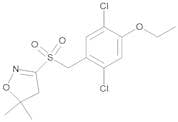
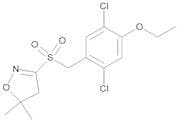
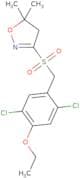
![3-[(2,5-dichloro-4-ethoxy-phenyl)methylsulfonyl]-5,5-dimethyl-4H-isoxazole](/_next/image/?url=https%3A%2Fstatic.cymitquimica.com%2Fcas-image%2Fthumb-webp%2F447916-fenoxasulfone.webp&w=3840&q=75)
CAS 639826-16-7
:3-[(2,5-dichloro-4-ethoxy-phenyl)methylsulfonyl]-5,5-dimethyl-4H-isoxazole
Description:
3-[(2,5-Dichloro-4-ethoxy-phenyl)methylsulfonyl]-5,5-dimethyl-4H-isoxazole is a synthetic organic compound characterized by its complex structure, which includes an isoxazole ring, a sulfonyl group, and a dichloro-substituted phenyl moiety. The presence of the isoxazole ring contributes to its potential biological activity, as this heterocyclic structure is often found in pharmaceuticals. The sulfonyl group enhances the compound's solubility and reactivity, making it suitable for various chemical reactions. The dichloro and ethoxy substituents on the phenyl ring may influence the compound's lipophilicity and biological interactions. This compound is typically studied for its potential applications in medicinal chemistry, particularly in the development of new therapeutic agents. Its specific properties, such as melting point, solubility, and reactivity, would depend on the molecular interactions and the environment in which it is used. As with many synthetic compounds, safety and handling precautions are essential due to potential toxicity or reactivity.
Formula:C14H17Cl2NO4S
InChI:InChI=1/C14H17Cl2NO4S/c1-4-20-12-6-10(15)9(5-11(12)16)8-22(18,19)13-7-14(2,3)21-17-13/h5-6H,4,7-8H2,1-3H3
SMILES:CCOc1cc(c(cc1Cl)CS(=O)(=O)C1=NOC(C)(C)C1)Cl
Synonyms:- 639826-16-7
- Fenoxasulfone
- T5No Eutj C1 C1 Esw1R Bg Eg Do2
- FENOXASULFONE STANDARD
- Isoxazole, 3-[[(2,5-dichloro-4-ethoxyphenyl)methyl]sulfonyl]-4,5-dihydro-5,5-dimethyl-
Sort by
Purity (%)
0
100
|
0
|
50
|
90
|
95
|
100
Found 3 products.
Fenoxasulfone
CAS:Fenoxasulfone is a potent inhibitor of cyclin-dependent kinases (CDKs) that has shown promise as an anticancer agent. It is an analog of the urine-derived CDK inhibitor roscovitine and has been found to induce apoptosis in cancer cells. Fenoxasulfone inhibits the activity of several CDKs, including CDK2, CDK4, and CDK9, which are involved in cell cycle regulation and transcriptional control. This inhibition leads to a decrease in tumor cell proliferation and an increase in cancer cell death. Fenoxasulfone has been tested in Chinese hamster ovary cells and human cancer cell lines and has shown significant antitumor activity. This drug may be useful for the treatment of various types of cancer, particularly those with high levels of CDK activity.Formula:C14H17Cl2NO4SPurity:Min. 95%Molecular weight:366.3 g/mol