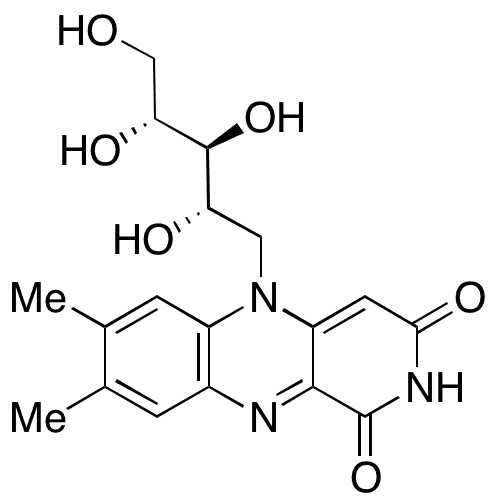
![1-deoxy-1-(7,8-dimethyl-1,3-dioxo-2,3-dihydropyrido[3,4-b]quinoxalin-5(1H)-yl)pentitol](/_next/image/?url=https%3A%2Fstatic.cymitquimica.com%2Fcas-image%2Fthumb-webp%2F77481-1-deoxy-1-78-dimethyl-13-dioxo-23-dihydropyrido-34-b-quinoxalin-5-1h-yl-pentitol.webp&w=3840&q=75)
CAS 64183-66-0
:1-deoxy-1-(7,8-dimethyl-1,3-dioxo-2,3-dihydropyrido[3,4-b]quinoxalin-5(1H)-yl)pentitol
Description:
1-Deoxy-1-(7,8-dimethyl-1,3-dioxo-2,3-dihydropyrido[3,4-b]quinoxalin-5(1H)-yl)pentitol is a complex organic compound characterized by its unique structural features, including a pentitol sugar moiety and a pyridoquinoxaline derivative. The presence of the dioxo functional groups indicates potential reactivity, particularly in forming hydrogen bonds or participating in redox reactions. This compound may exhibit biological activity due to its intricate structure, which could interact with various biological targets. The dimethyl substitutions on the pyridoquinoxaline ring suggest that it may possess lipophilic properties, potentially influencing its solubility and permeability in biological systems. Additionally, the stereochemistry of the pentitol component may affect its interaction with enzymes or receptors. Overall, this compound's characteristics suggest it could be of interest in medicinal chemistry, particularly in the development of pharmaceuticals or as a research tool in biochemical studies. Further investigation would be necessary to elucidate its specific properties and potential applications.
Formula:C18H21N3O6
InChI:InChI=1/C18H21N3O6/c1-8-3-10-11(4-9(8)2)21(6-13(23)17(26)14(24)7-22)12-5-15(25)20-18(27)16(12)19-10/h3-5,13-14,17,22-24,26H,6-7H2,1-2H3,(H,20,25,27)
SMILES:Cc1cc2c(cc1C)n(CC(C(C(CO)O)O)O)c1cc(nc(=O)c1n2)O
Sort by
Purity (%)
0
100
|
0
|
50
|
90
|
95
|
100
Found 2 products.
1-Deazariboflavin
CAS:Controlled ProductFormula:C18H21N3O6Color and Shape:NeatMolecular weight:375.3761-Deazariboflavin
CAS:<p>1-Deazariboflavin is an analog of riboflavin that has been shown to have potent anticancer activity. It functions as a kinase inhibitor, preventing the phosphorylation of proteins involved in cancer cell growth and survival. 1-Deazariboflavin has been found in urine samples from cancer patients, suggesting that it may play a role in the body's natural defense against cancer. Studies have shown that this compound induces apoptosis (programmed cell death) in human cancer cells, including those derived from breast, lung, and colon tumors. Additionally, 1-Deazariboflavin has been found to inhibit glycerol kinase activity in Chinese hamster ovary cells. These findings suggest that 1-Deazariboflavin may be a promising candidate for the development of novel anticancer therapies.</p>Formula:C18H21N3O6Purity:Min. 95%Molecular weight:375.4 g/mol