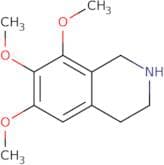
CAS 642-30-8
:1,2,3,4-Tetrahydro-6,7,8-trimethoxyisoquinoline
Description:
1,2,3,4-Tetrahydro-6,7,8-trimethoxyisoquinoline is a chemical compound belonging to the isoquinoline family, characterized by its bicyclic structure that includes a saturated tetrahydro moiety and multiple methoxy groups. This compound features a total of three methoxy (-OCH3) substituents located at the 6, 7, and 8 positions of the isoquinoline ring, which can influence its solubility and reactivity. The presence of these methoxy groups typically enhances the lipophilicity of the molecule, potentially affecting its biological activity and interaction with various receptors. The tetrahydro configuration indicates that the compound is a saturated derivative, which may contribute to its stability and reduce reactivity compared to unsaturated analogs. 1,2,3,4-Tetrahydro-6,7,8-trimethoxyisoquinoline has been studied for its potential pharmacological properties, including neuroprotective and anti-inflammatory effects, making it of interest in medicinal chemistry. Its CAS number, 642-30-8, serves as a unique identifier for regulatory and research purposes.
Formula:C12H17NO3
InChI:InChI=1S/C12H17NO3/c1-14-10-6-8-4-5-13-7-9(8)11(15-2)12(10)16-3/h6,13H,4-5,7H2,1-3H3
InChI key:InChIKey=GOBKARNYNSWQFZ-UHFFFAOYSA-N
SMILES:O(C)C1=C2C(=CC(OC)=C1OC)CCNC2
Synonyms:- Anhalinine
- Isoquinoline, 1,2,3,4-tetrahydro-6,7,8-trimethoxy-
- 6,7,8-Trimethoxy-1,2,3,4-tetrahydroisoquinoline
- 1,2,3,4-Tetrahydro-6,7,8-trimethoxyisoquinoline
Sort by
Purity (%)
0
100
|
0
|
50
|
90
|
95
|
100
Found 1 products.
6,7,8-Trimethoxy-1,2,3,4-tetrahydroisoquinoline
CAS:6,7,8-Trimethoxy-1,2,3,4-tetrahydroisoquinoline is a neurally active alkaloid found in the plant Solanum nigrum. It has been shown to act as an antagonist of acetylcholine at the neuromuscular junction. This compound has also been shown to have muscle relaxant properties and can be used as a potential treatment for acute gastral spasms. 6,7,8-Trimethoxy-1,2,3,4-tetrahydroisoquinoline also has calcium hydrogen phosphate binding properties and may play a role in carbohydrate metabolism. This natural compound may also have addictive properties due to its effects on the cholinergic system.Formula:C12H17NO3Purity:Min. 95%Molecular weight:223.27 g/mol