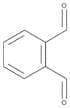
CAS 643-79-8
:Phthalaldehyde
Description:
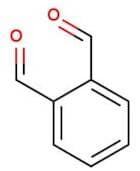
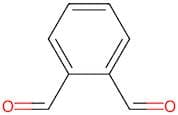
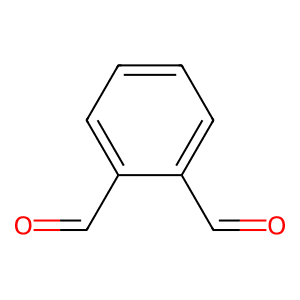
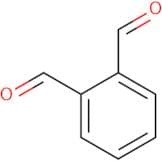
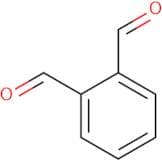
Phthalaldehyde, also known as 1,2-benzenedicarboxaldehyde, is an organic compound with the chemical formula C8H6O2 and the CAS number 643-79-8. It is characterized by the presence of two aldehyde functional groups attached to a benzene ring, which contributes to its reactivity and utility in various chemical applications. Phthalaldehyde is typically a colorless to pale yellow liquid with a strong, pungent odor. It is soluble in organic solvents such as ethanol and ether but has limited solubility in water. This compound is primarily used as a precursor in the synthesis of various chemicals, including pharmaceuticals and dyes, and as a cross-linking agent in polymer chemistry. Additionally, phthalaldehyde exhibits properties that make it useful in the field of fluorescence, as it can form fluorescent derivatives. However, it is important to handle this substance with care, as it may pose health risks upon exposure, including irritation to the skin, eyes, and respiratory system.
Formula:C8H6O2
InChI:InChI=1S/C8H6O2/c9-5-7-3-1-2-4-8(7)6-10/h1-6H
InChI key:InChIKey=ZWLUXSQADUDCSB-UHFFFAOYSA-N
SMILES:C(=O)C1=C(C=O)C=CC=C1
Synonyms:- 1,2-Benzenedialdehyde
- 1,2-Benzenedicarboxaldehyde
- 1,2-Diformylbenzene
- 1,2-Formylbenzene
- 1,2-Phthalaldehyde
- 2-Formylbenzaldehyde
- 2-Phthalaldehyde
- Benzene-1,2-Dicarbaldehyde
- Benzene-1,2-dicarboxaldehyde
- Cidex Opa
- Ftalaldehido
- Nsc 13394
- O-Phtalaldehyde
- O-Phthaladehyde
- O-Phthalaldehyde
- OPA
- Op 100S
- Op 100Sf
- Phtalaldehyde
- Phthalaldehyd
- Phthalaldehyde
- Phthaldialdehyde
- Phthalic aldehyde
- Phthalic dialdehyde
- Phthalyldicarboxaldehyde
- Phtharal
- o-Benzenedicarbaldehyde
- o-Diformylbenzene
- o-Phthalaldehyde (1.11452)
- o-Phthaldialdehyde
- o-Phthaldialdehyde OPD
- o-Phthalic dialdehyde
- See more synonyms
Sort by
Purity (%)
0
100
|
0
|
50
|
90
|
95
|
100
Found 14 products.
o-Phthalaldehyde [for HPLC Labeling]
CAS:Formula:C8H6O2Purity:>99.0%(GC)Color and Shape:Light yellow to Yellow to Green powder to crystalMolecular weight:134.13Phthaldialdehyde, 98%
CAS:Phthaldialdehyde is used as a fluorescent reagent for checking the assay of amines present in proteins, peptides by capillary electrophoresis and chromatography. It is also used for cholesterol assay in the picomole range as well as for fluorometric determination of histamine, histidine and other amFormula:C8H6O2Purity:98%Color and Shape:Crystals, crystalline powder or lumps, Pale yellow to yellowMolecular weight:134.132-Phthaldehyde, High purity
CAS:2-Phthaldehyde, High purityFormula:C8H6O2Purity:99% (Typical Value in Batch COA)Color and Shape: light yellow to yellow to green crystal to powderMolecular weight:134.13g/mol2-Phthaldialdehyde
CAS:2-PhthaldialdehydeFormula:C8H6O2Purity:By gc: 98.3% by area (Typical Value in Batch COA)Color and Shape: yellow powderMolecular weight:134.13g/molo-Phthaldialdehyde
CAS:Formula:C8H6O2Purity:(GC) ≥ 97.5%Color and Shape:Pale yellow to yellow crystalline powder or solidMolecular weight:134.14Phthalaldehyde
CAS:PhthalaldehydeFormula:C8H6O2Purity:98%Color and Shape: yellow crystalline solidMolecular weight:134.13204g/molo-Phthaldialdehyde, 99%
CAS:Formula:C8H6O2Purity:≥ 99.0%Color and Shape:White to pale yellow to yellow crystalline powder or crystalsMolecular weight:134.14o-Phthalaldehyde
CAS:Controlled ProductApplications o-Phthalaldehyde is a compound that reacts with primary amines to produce a product that emits a highly fluorescent blue colour. o-Phthalaldehyde is used for the quick visualization of histamine, characterized by the appearance of a yellow stain.
Not a dangerous good if item is equal to or less than 1g/ml and there is less than 100g/ml in the package
References Juhlin, J. & Shelley, W.: J. Histochem. Cytochem., 14, 525 (1966); Marton, L. & Lee, P.: Clin. Chem., 21, 1721 (1975)Formula:C8H6O2Color and Shape:NeatMolecular weight:134.13Phthalaldehyde
CAS:Phthalaldehyde is a disinfectant that is used for the prevention of microbial contamination in the manufacturing process of pharmaceuticals, cosmetics, and many other products. It has been shown to inhibit the growth of bacteria by inhibiting protein synthesis. The mechanism of action is thought to be due to its reaction with amino acids, which are important for protein synthesis. Phthalaldehyde also reacts with benzalkonium chloride to form a fluorescent derivative, which can be detected using fluorescence detectors or LC-MS/MS methods. The use of this compound as a fluorescence probe allows for the detection of probiotic bacteria in nutrient solutions without the need for expensive equipment or complicated analytical methods.Formula:C8H6O2Purity:Min. 98%Color and Shape:PowderMolecular weight:134.13 g/molPhthaldialdehyde
CAS:Formula:C8H6O2Purity:98%Color and Shape:Solid, Powder or Crystalline Powder or Solid or LumpsMolecular weight:134.1342-Phthalaldehyde
CAS:For precolumn derivatization of amino acids for HPLC separation. For flow cytometric measurements of protein thiol groups.Formula:C8H6O2Molecular weight:134.14 g/molRef: 3D-P-6600
-Unit-kgkgTo inquire1kgTo inquire5kgTo inquire10kgTo inquire500gTo inquire2500gTo inquireo-Phthalaldehyde (OPA) extrapure AR, 99%
CAS:Formula:C8H6O2Purity:min. 99%Color and Shape:Pale yellow, Crystalline powder, Clear, YellowMolecular weight:134.13
![o-Phthalaldehyde [for HPLC Labeling]](/_next/image/?url=https%3A%2Fstatic.cymitquimica.com%2Fproducts%2F3B%2Fthumb%2FP0280.jpg&w=3840&q=75)