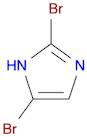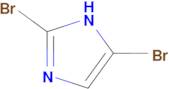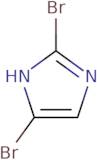
CAS 64591-03-3
:Formula:C3H2Br2N2
InChI:InChI=1S/C3H2Br2N2/c4-2-1-6-3(5)7-2/h1H,(H,6,7)
InChI key:KJBTZMYWBSAZAQ-UHFFFAOYSA-N
SMILES:C1=C(NC(=N1)Br)Br
Filter by
Purity percentage
0
100
|
0
|
50
|
90
|
95
|
100
Found 5 products.
- Lower prices
- Higher prices
- Lower purities
- Higher purities
- Faster estimated delivery
2,5-Dibromo-1H-imidazole
CAS:Formula:C3H2Br2N2Purity:95%Color and Shape:SolidMolecular weight:225.86942,4-Dibromo-1H-imidazole
CAS:2,4-Dibromo-1H-imidazoleFormula:C3H2Br2N2Purity:97%Color and Shape:Solid-PowderMolecular weight:225.869372,4-Dibromo-1H-imidazole
CAS:Formula:C3H2Br2N2Purity:95%Color and Shape:SolidMolecular weight:225.8712,5-Dibromo-1H-imidazole
CAS:2,5-Dibromo-1H-imidazoleFormula:C3H2Br2N2Purity:98%Molecular weight:225.872,4-Dibromo-1H-imidazole
CAS:2,4-Dibromo-1H-imidazole is a boronate. It is used in the synthesis of heterocyclic compounds. In this process, 2,4-dibromo-1H-imidazole reacts with an alkyl or aryl halide to form a boronic acid that can be coupled with other molecules to form new products. The boronic acids made from 2,4-dibromo-1H-imidazole are versatile intermediates for organic synthesis and can be used as starting materials for the preparation of pharmaceuticals and other useful substances. 2,4-Dibromo-1H-imidazole is also used in Suzuki reactions to form carbon–carbon bonds. This reaction uses palladium as a catalyst to generate new carbon–carbon bonds between two different organic molecules.Formula:C3H2Br2N2Purity:Min. 95%Molecular weight:225.87 g/mol