CAS 64790-15-4
:Glucagon (19-29) (human, bovine, porcine)
Description:
Glucagon (19-29) is a peptide fragment derived from the larger glucagon molecule, which plays a crucial role in glucose metabolism and regulation. This specific fragment consists of amino acids 19 to 29 of the glucagon sequence and is known for its biological activity in stimulating glycogenolysis and gluconeogenesis in the liver, thereby increasing blood glucose levels. The CAS number 64790-15-4 identifies this particular peptide, which is relevant in both human and animal physiology, including bovine and porcine species. Characteristically, glucagon (19-29) is a hydrophilic molecule, typically exhibiting a high degree of solubility in aqueous solutions, which is essential for its biological function. It is often utilized in research and clinical settings to study metabolic processes and potential therapeutic applications in conditions like hypoglycemia and diabetes. The stability and activity of this peptide can be influenced by factors such as pH, temperature, and the presence of other ions or molecules in the solution.
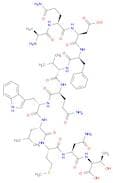
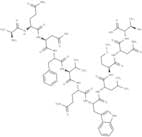
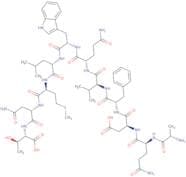
Formula:C61H89N15O18S
InChI:InChI=1/C61H89N15O18S/c1-29(2)23-40(55(87)68-39(21-22-95-7)54(86)73-43(26-47(65)80)59(91)76-50(32(6)77)61(93)94)70-56(88)42(25-34-28-66-36-16-12-11-15-35(34)36)72-53(85)38(18-20-46(64)79)69-60(92)49(30(3)4)75-58(90)41(24-33-13-9-8-10-14-33)71-57(89)44(27-48(81)82)74-52(84)37(17-19-45(63)78)67-51(83)31(5)62/h8-16,28-32,37-44,49-50,66,77H,17-27,62H2,1-7H3,(H2,63,78)(H2,64,79)(H2,65,80)(H,67,83)(H,68,87)(H,69,92)(H,70,88)(H,71,89)(H,72,85)(H,73,86)(H,74,84)(H,75,90)(H,76,91)(H,81,82)(H,93,94)/t31-,32+,37-,38-,39-,40-,41-,42-,43-,44-,49-,50-/m0/s1
Synonyms:- H-Ala-Gln-Asp-Phe-Val-Gln-Trp-Leu-Met-Asn-Thr-OH
- L-alanyl-L-glutaminyl-L-alpha-aspartyl-L-phenylalanyl-L-valyl-L-glutaminyl-L-tryptophyl-L-leucyl-L-methionyl-L-asparaginyl-L-threonine
- Miniglucagon (huMan, rat, porcine)
- GLUCAGON (19-29) (HUMAN, BOVINE, PORCINE)
- Glucagon (19-29) (huMan, rat, porcine)
- L-Alanyl-L-glutaminyl-L-a-aspartyl-L-phenylalanyl-L-valyl-L-glutaminyl-L-tryptophyl-L-leucyl-L-methionyl-L-asparaginyl-L-threonine
- L-Threonine, L-alanyl-L-glutaminyl-L-α-aspartyl-L-phenylalanyl-L-valyl-L-glutaminyl-L-tryptophyl-L-leucyl-L-methionyl-L-asparaginyl-
- glucagon(19-29
- GLUCAGON (19-29), BOVINE, HUMAN, PORCINE
- PHE-VAL-GLN-TRP-LEU-MET-ASN-THR: FVQWLMNT
- GLUCAGON (19-29), HUMAN
- AQDFVQWLMNT
- ALA-GLN-ASP-PHE-VAL-GLN-TRP-LEU-MET-ASN-THR
- Glucagon (19-29) (human, rat, porcine)
- See more synonyms
Sort by
Purity (%)
0
100
|
0
|
50
|
90
|
95
|
100
Found 4 products.
Glucagon (19-29) (human, rat, porcine)
CAS:Miniglucagon inhibited both the Ca²⁺ activated and Mg²⁺ dependent ATPase activity and Ca²⁺ transport in liver plasma membranes with an efficiency 1000-fold higher than that of glucagon. It is likely to be the active peptide involved in the inhibition of the liver Ca²⁺ pump. Miniglucagon, the ultimate processing product of proglucagon, is a regulator of the pancreatic islet physiology.Formula:C61H89N15O18SPurity:> 96%Color and Shape:White PowderMolecular weight:1352.53H-Ala-Gln-Asp-Phe-Val-Gln-Trp-Leu-Met-Asn-Thr-OH
CAS:Formula:C61H89N15O18SPurity:95%Color and Shape:SolidMolecular weight:1352.5141Glucagon (19-29), human
CAS:Glucagon, a 29-amino-acid hormone, is produced by alpha cells in the pancreas' islets of Langerhans.Formula:C61H89N15O18SPurity:98%Color and Shape:SolidMolecular weight:1352.53Glucagon (19-29) (human, rat, porcine) trifluoroacetate salt
CAS:Glucagon is a peptide hormone that belongs to the group of vasoactive intestinal peptides. It is produced by the alpha cells of the pancreas and stimulates gluconeogenesis in the liver, thereby increasing blood glucose levels. Glucagon has also been shown to cause membrane hyperpolarization and cell death in cancer cells. Glucagon is a homologous protein that has been shown to have physiological effects similar to those of insulin, such as increased levels of cytosolic Ca2+ ions and camp levels. Glucagon binds to its receptor on the plasma membrane with high affinity, activating adenylate cyclase and phospholipase C, which leads to an increase in intracellular camp levels. This results in activation of protein kinase A (PKA), which phosphorylates proteins involved in glycogenolysis, glycolysis, and lipolysis. Glucagon also activates mitogen-activated protein kinases (MAPKFormula:C61H89N15O18SPurity:Min. 95%Molecular weight:1,352.52 g/mol