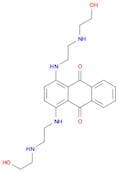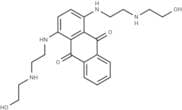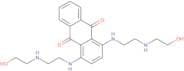
CAS 64862-96-0
:Ametantrone
Description:
Ametantrone is a synthetic anthraquinone derivative primarily recognized for its application in cancer therapy, particularly in the treatment of certain types of leukemia and solid tumors. It functions as an antineoplastic agent, exhibiting cytotoxic properties by intercalating into DNA and inhibiting topoisomerase II, which disrupts DNA replication and transcription. Ametantrone is characterized by its dark blue color and is soluble in organic solvents, but its solubility in water is limited. The compound has a relatively complex structure, which contributes to its biological activity and pharmacological effects. It is important to note that, like many chemotherapeutic agents, ametantrone can have significant side effects, including cardiotoxicity and myelosuppression, necessitating careful monitoring during treatment. Additionally, its use is often restricted to specific clinical settings due to these potential adverse effects. Overall, ametantrone represents a significant compound in the field of oncology, with ongoing research aimed at optimizing its therapeutic efficacy and minimizing toxicity.
Formula:C22H28N4O4
InChI:InChI=1S/C22H28N4O4/c27-13-11-23-7-9-25-17-5-6-18(26-10-8-24-12-14-28)20-19(17)21(29)15-3-1-2-4-16(15)22(20)30/h1-6,23-28H,7-14H2
InChI key:InChIKey=FFGSXKJJVBXWCY-UHFFFAOYSA-N
SMILES:N(CCNCCO)C1=C2C(=C(NCCNCCO)C=C1)C(=O)C=3C(C2=O)=CC=CC3
Synonyms:- 9,10-Anthracenedione, 1,4-bis[[2-[(2-hydroxyethyl)amino]ethyl]amino]-
- 1,4-Bis[2-(2-hydroxyethylamino)ethylamino]anthraquinone
- Ametantrone
- 1,4-Bis[[2-[(2-hydroxyethyl)amino]ethyl]amino]-9,10-anthracenedione
- NSC 196473
Sort by
Purity (%)
0
100
|
0
|
50
|
90
|
95
|
100
Found 4 products.
Ametantrone
CAS:Ametantrone: synthetic 9,10-anthracenedione with 1,4-ethylamino residues, 2nd to enter clinical trials.Formula:C22H28N4O4Purity:98%Color and Shape:SolidMolecular weight:412.48Ametantrone
CAS:Ametantrone is a pyrazole-based compound that has been used as an antimicrobial agent and as an antineoplastic agent in the treatment of cancer. It has been shown to be effective against solid tumours, such as those found in mice. Ametantrone is genotoxic and its activity may be due to inhibition of the production of epidermal growth factor, which is important for the proliferation of cells. Ametantrone inhibits the growth of certain bacteria by binding to DNA at specific sites, causing strand breakage and inhibiting DNA synthesis. The inhibitory dose for ametantrone was determined using in vitro assays on human lymphocytes.Formula:C22H28N4O4Purity:90%MinMolecular weight:412.48 g/mol