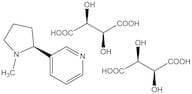
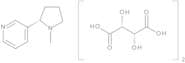
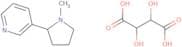
CAS 65-31-6
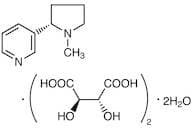
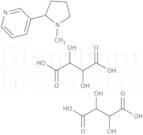
:(-)-Nicotine hydrogen (+)-tartrate
Description:
(-)-Nicotine hydrogen (+)-tartrate, with the CAS number 65-31-6, is a salt formed from the alkaloid nicotine and tartaric acid. This compound is characterized by its chiral nature, as it contains both the (-)-nicotine, which is the naturally occurring enantiomer, and the (+)-tartrate ion. It typically appears as a white crystalline solid and is soluble in water, which is a common property of many salts. The compound exhibits pharmacological activity, primarily due to the presence of nicotine, which acts as a stimulant affecting the central nervous system. Its applications are often found in research settings, particularly in studies related to nicotine's effects on neurotransmission and addiction. Additionally, the presence of the tartrate moiety can influence the compound's stability and solubility, making it relevant in the formulation of pharmaceuticals. Overall, (-)-Nicotine hydrogen (+)-tartrate serves as an important compound in both chemical research and potential therapeutic applications.
Formula:C18H26N2O12
InChI:InChI=1/C10H14N2.C4H6O6/c1-12-7-3-5-10(12)9-4-2-6-11-8-9;5-1(3(7)8)2(6)4(9)10/h2,4,6,8,10H,3,5,7H2,1H3;1-2,5-6H,(H,7,8)(H,9,10)/t10-;/m0./s1
InChI key:InChIKey=QLDPCHZQQIASHX-LDGFUSNJSA-N
SMILES:[C@@H]([C@H](C(O)=O)O)(C(O)=O)O.CN1[C@@H](CCC1)C=2C=CC=NC2
Synonyms:- (-)-Nicotine ditartrate
- (-)-Nicotine hydrogen (+)-tartrate
- 3-(1-Methylpyrrolidin-2-Yl)Pyridine 2,3-Dihydroxybutanedioate (1:1)
- 3-[(2S)-1-methylpyrrolidin-2-yl]pyridine 2,3-dihydroxybutanedioate (salt)
- 3-[(2S)-1-methylpyrrolidin-2-yl]pyridine bis(2,3-dihydroxybutanedioate) (salt)
- NSC 97238
- Nicotine acid tartrate
- Nicotine bitartrate
- Nicotine tartrate
- Nicotine, tartrate (1:2)
- Np002
- Pyridine, 3-(1-methyl-2-pyrrolidinyl)-, (S)-, [R-(R*,R*)]-2,3-dihydroxybutanedioate (1:2)
- Pyridine, 3-[(2S)-1-methyl-2-pyrrolidinyl]-, (2R,3R)-2,3-dihydroxybutanedioate (1:2)
- S-(-)-Nicotine hydrogen-(+)-tartrate
- pyridine,3-(1-methyl-2-pyrrolidinyl)-,(s)-,(r-(r*,r*))-2,3-dihydroxybutanedi
- nicotinehydrogentartrate
- tartratedenicotine
- (S)-3-(1-METHYL-2-PYRROLIDINYL)PYRIDINE TARTRATE SALT
- (-)-NICOTINE TARTRATE SALT
- (-)-1-METHYL-2-[3-PYRIDYL]PYRROLIDINE DI-(+) TARTRATE SALT
- nicotineacidtartrate
- pyridine,3-(1-methyl-2-pyrrolidinyl)-,(s)-,(r-(r*,r*))-2,3-dihydroxybutane
- NICOTINE HYDROGEN-L-TARTRATE
- (-)-NICOTINE HYDROGEN TARTRATE SALT
- (-)-nicotinehydrogentartrate
- nikotinbitartrat
- (S)-3-(1-METHYL-2-PYRROLINDINYL)PYRIDINE TARTRATE SALT
- (S)-3-(1-METHYL-2-PYRROLIDINYL)PYRIDINE, DI-D-TARTRATE
- (S)-3-(1-METHYL-2-PYRROLINDINYL)PYRIDINE, DI-D-TARTRATE
- See more synonyms
Sort by
Purity (%)
0
100
|
0
|
50
|
90
|
95
|
100
Found 8 products.
Nicotine Bi-L-(+)-tartrate Dihydrate
CAS:Formula:C10H14N2·2C4H6O6·2H2OPurity:>98.0%(HPLC)Color and Shape:White to Almost white powder to crystalMolecular weight:498.44(-)-Nicotine hydrogen tartrate salt
CAS:Formula:C10H14N2·2C4H6O6(anhydrous)Purity:(HPLC) 98.5 - 101.5 % (anhydrous basis)Color and Shape:White to almost white powderMolecular weight:462.41 (anhydrous)Nicotine ditartrate
CAS:Controlled ProductFormula:C10H14N2C4H6O6Color and Shape:NeatMolecular weight:462.41Nicotine ditartrate
CAS:Natural alkaloidFormula:C10H14N2C4H6O6Purity:≥ 95.0 % (HPLC)Color and Shape:PowderMolecular weight:462.41(-)-Nicotine Ditartrate
CAS:Applications (-)-Nicotine ditartrate is a potent agonist of AChR.
Not a dangerous good if item is equal to or less than 1g/ml and there is less than 100g/ml in the package
References Rodriguez, J. et al.: Psychopharmacol., 231, 4455 (2014);Formula:C10H14N2·2C4H6O6Color and Shape:NeatMolecular weight:462.41(-)-Nicotine ditartrate
CAS:(-)-Nicotine ditartrate is a polymorphic form of nicotine. It is a hydrogen tartrate salt with the chemical formula C10H14N2O4·H2O. (-)-Nicotine ditartrate has been shown to improve locomotor activity and reduce cortisol concentration in mice. In addition, this compound has been shown to inhibit oxidative injury in mice by reducing reactive oxygen species production. (-)-Nicotine ditartrate is also able to inhibit glutamate release from nerve terminals, which may be due to its ability to stimulate nicotinic acetylcholine receptors (nAChRs). Further, it can induce apoptosis in cancer cells through activation of the MCL-1 protein and inhibition of cholinergic neurotransmission. This drug can also be used as an electrochemical impedance spectroscopy probe for the detection of reactive oxygen species.Formula:C10H14N2·2C4H6O6Purity:Min. 95%Molecular weight:462.41 g/mol