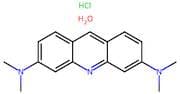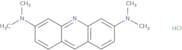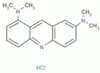
CAS 65-61-2
:Acridine Orange
Description:
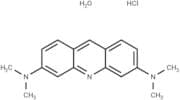
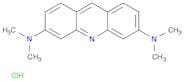
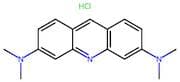
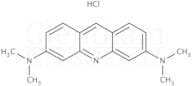
Acridine Orange is a synthetic fluorescent dye commonly used in biological and biochemical applications, particularly in microscopy and cell staining. It is characterized by its ability to intercalate into nucleic acids, allowing for the differentiation between live and dead cells based on their membrane integrity. The compound exhibits a strong fluorescence under ultraviolet light, with distinct emission spectra that vary depending on its binding state; it fluoresces green when bound to RNA and red when bound to DNA. Acridine Orange is soluble in water and organic solvents, making it versatile for various experimental conditions. Its chemical structure includes an acridine ring system, contributing to its planar configuration, which facilitates intercalation. Due to its properties, Acridine Orange is widely utilized in research for studying cellular processes, assessing cell viability, and detecting nucleic acids in various samples. However, caution is advised when handling this compound, as it can be mutagenic and potentially harmful to human health.
Formula:C17H20ClN3
InChI:InChI=1/C17H19N3.ClH/c1-19(2)14-7-5-12-9-13-6-8-15(20(3)4)11-17(13)18-16(12)10-14;/h5-11H,1-4H3;1H
InChI key:InChIKey=VSTHNGLPHBTRMB-UHFFFAOYSA-N
SMILES:N(C)(C)C1=CC2=C(C=C3C(=N2)C=C(N(C)C)C=C3)C=C1.Cl
Synonyms:- 3,6-Acridinediamine, N,N,N',N'-tetramethyl-, monohydrochloride
- 3,6-Acridinediamine, N3,N3,N6,N6-tetramethyl-, hydrochloride (1:1)
- 3,6-Acridinediamine, N<sup>3</sup>,N<sup>3</sup>,N<sup>6</sup>,N<sup>6</sup>-tetramethyl-, hydrochloride (1:1)
- 3,6-Bis(dimethylamino)acridine hydrochloride
- Acridine Orange N
- Acridine Orange NO
- Acridine Orange NS
- Acridine Orange R
- Acridine orange
- Acridine, 3,6-bis(dimethylamino)-, hydrochloride
- Acridine, 3,6-bis(dimethylamino)-, monohydrochloride
- Basic Orange 14
- Basic Orange 3RN
- N,N,N',N'-Tetramethyl-3,6-acridinediamine, monohydrochloride
- N,N,N',N'-Tetramethylacridin-3,6-yldiamine, chlorhydrate
- N,N,N',N'-Tetramethylacridin-3,6-yldiaminhydrochlorid
- N,N,N',N'-tetramethylacridine-1,7-diamine hydrochloride (1:1)
- N,N,N',N'-tetramethylacridine-3,6-diamine hydrochloride (1:1)
- N,N,N',N'-tetramethylacridine-3,6-yldiamine, chlorhydrate
- N,N,N',N'-tetrametilacridin-3,6-ildiamina, clorhidrato
- Rhoduline Orange NO
- Sumitomo Acridine Orange NO
- Sumitomo Acridine Orange RK conc
- C.I. Basic Orange 14
- Acridine Orange, hydrochloride hydrate, ca. 80 % dye content, pure
- BASIC ORANGE
- ACRIDINE ORANGE HYDROCHLORIDE HYDRATE PURUM, FOR MICROSCOPY ((FL., HIST.)) 98%
- AOX1
- acridineorangeno
- 3,6-bis(dimethylamino)-, Monohydrochloride
- ACRIDINE ORANGE SOLUTION
- N,N,N',N'-tetramethylacridin-3,6-yldiamine hydrochloride
- Acridine Orange solution hydrochloride
- ACRIDINE ORANGE HYDROCHLORIDE
- ACRIDING ORANGE HYDROCHLORIDE
- CI NO 46005
- Basic orange 14 (C.I. 46005)
- Euchrysine 3r
- Acridine Orange hydrochloride solution,3,6-Bis(dimethylamino)acridine hydrochloride
- 3,6-acridinediamine, N,n,n0,n0-tetramethyl-,
- AO
- BIS(DIMETHYLAMINO) ACRIDINE HYDROCHLORIDE
- RHODULINE ORANGE
- 6-acridinediamine,n,n,n’,n’-tetramethyl-monohydrochloride
- 3,6-bis(dimethylamino)-, Hydrochloride
- monohydrochloride
- ACRIDINE ORANGE HYDROCHLORIDE HYDRATE 80%
- Sumitomo
- c.i.basicorange14
- ACRIDINE ORANGE HYDROCHLORIDE SOLUTION, ~1% IN WATER
- 3,6-BIS(DIMETHYLAMINO)ACRIDINE, HCL
- acridineoranger
- Acridine Orange hydrate hydrochloride
- 3,6-Bis(dimethylamino) acridine, zinc chloride double salt
- ACRIDINE ORANGE N-HYRATE
- acridine orange hydrochloride solution
- 3,6-Bis(dimethylamino)acridine,hydrochloride,hydrate,aqueoussolution
- -Cellstain-Ao
- ACRIDINE ORANGE HYDROCHLORIDE HYDRATE, F OR MICROSCOPY
- -Cellstain-AoSolution
- 3,6-bis(dimethylamino)-acridinmonohydrochloride
- ACRIDINE ORANGE (E GURR)
- Acridine Orange, hydrochloride hydrate,pure,ca. 80 % dye content
- acridine Orange Rk Conc
- rhodulineorangeno
- Acridine,
- EUCHRYSINE 3RX
- ACRIDINE ORANGE FOR MICROSCOPY
- See more synonyms
Sort by
Purity (%)
0
100
|
0
|
50
|
90
|
95
|
100
Found 9 products.
Acridine Orange Solution [for Cell Staining]
CAS:Formula:C17H19N3·HClColor and Shape:Light yellow to Brown clear liquidMolecular weight:301.82Acridine Orange hydrochloride
CAS:Acridine Orange is a cell-permeable fluorescent dye, binding to nucleic acids, used for staining and fluorescence cytochemistry; may mutate microorganisms.Formula:C17H20ClN3Purity:98.27% - 99.3%Color and Shape:Orange PowderMolecular weight:301.813,6-Acridinediamine, N,N,N',N'-tetramethyl-, monohydrochloride
CAS:Formula:C17H20ClN3Purity:98%Color and Shape:SolidMolecular weight:301.8138N3,N3,N6,N6-Tetramethylacridine-3,6-Diamine Hydrochloride
CAS:N3,N3,N6,N6-Tetramethylacridine-3,6-Diamine HydrochloridePurity:99%Molecular weight:301.81g/molAcridine Orange hydrochloride hydrate
CAS:Formula:C17H19N3·HCl·xH2OColor and Shape:Dark orange to dark red powderMolecular weight:301.81 (anhydrous)Acridine Orange hydrochloride
CAS:Acridine Orange hydrochloridePurity:≥98%Molecular weight:301.81g/molAcridine Orange Hydrochloride Hydrate for molecular biology, 99%
CAS:Formula:C17H19N3·HCl·xH2OPurity:min. 99%Color and Shape:Brown, PowderMolecular weight:301.81Acridine Orange hydrochloride hydrate
CAS:Formula:C17H20ClN3Purity:98%Color and Shape:Solid, Crystalline Powder or Lumps or PowderMolecular weight:301.82Acridine orange hydrochloride hydrate
CAS:Acridine orange hydrochloride hydrate is a fluorescent dye that is used as a nucleic acid stain. It can be used to detect the presence of dna in cells. Acridine orange hydrochloride hydrate binds to DNA, intercalates into the double helix, and changes its fluorescence properties. This dye was first synthesized in 1927 by German chemists, but it was not until 1953 that the biological applications became clear. Acridine orange hydrochloride hydrate has been shown to bind to the nuclear DNA of human HL-60 cells and inhibit the polymerase chain reaction (PCR). Acridine orange hydrochloride hydrate is also capable of inhibiting enzyme activities and reactions involving transfer reactions.Formula:C17H20ClN3Purity:Min. 95%Molecular weight:301.8 g/mol
![Acridine Orange Solution [for Cell Staining]](/_next/image/?url=https%3A%2Fstatic.cymitquimica.com%2Fproducts%2F3B%2Fthumb%2FA3396.jpg&w=3840&q=75)