CAS 65092-53-7
:1-Chloro-4-nitroisoquinoline
Description:
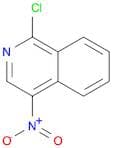
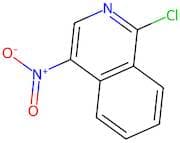
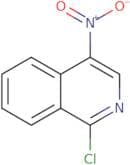
1-Chloro-4-nitroisoquinoline is an organic compound characterized by its isoquinoline structure, which features a nitrogen atom within a bicyclic aromatic system. This compound contains both a chloro group and a nitro group, which are positioned at the 1 and 4 positions of the isoquinoline ring, respectively. The presence of these functional groups contributes to its reactivity and potential applications in various chemical reactions, including nucleophilic substitutions and electrophilic aromatic substitutions. 1-Chloro-4-nitroisoquinoline is typically a yellow to orange solid, and it is soluble in organic solvents such as dichloromethane and dimethyl sulfoxide. Its chemical properties make it of interest in medicinal chemistry and materials science, where it may serve as a precursor for the synthesis of more complex molecules. Additionally, the compound's unique structure may impart specific biological activities, warranting further investigation in pharmacological studies. As with many nitro compounds, it is important to handle 1-chloro-4-nitroisoquinoline with care due to potential toxicity and environmental concerns.
Formula:C9H5ClN2O2
InChI:InChI=1/C9H5ClN2O2/c10-9-7-4-2-1-3-6(7)8(5-11-9)12(13)14/h1-5H
SMILES:c1ccc2c(c1)c(cnc2Cl)N(=O)=O
Synonyms:- Isoquinoline, 1-Chloro-4-Nitro-
Sort by
Purity (%)
0
100
|
0
|
50
|
90
|
95
|
100
Found 4 products.
1-CHLORO-4-NITROISOQUINOLINE
CAS:Formula:C9H5ClN2O2Purity:95%Color and Shape:SolidMolecular weight:208.61-Chloro-4-nitroisoquinoline
CAS:1-Chloro-4-nitroisoquinoline is an antagonist of the alpha2-adrenergic receptor. It binds to the receptor and blocks the binding of agonists such as clonidine, causing a decrease in lipolysis and vasoconstriction. This agent has been shown to have a low affinity for other receptors, such as dopamine, histamine, serotonin, acetylcholine, and opioid receptors. 1-Chloro-4-nitroisoquinoline has been used to treat hypertension, Raynaud's phenomenon (a disorder that causes reduced blood flow to the fingers or toes), and benign prostatic hypertrophy (enlargement of the prostate).Formula:C9H5ClN2O2Purity:Min. 95%Molecular weight:208.6 g/mol