CAS 6515-38-4
:3,5,6-Trichloro-2-pyridinol
Description:
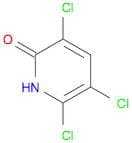
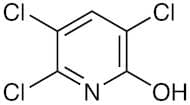
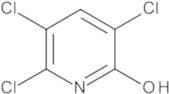
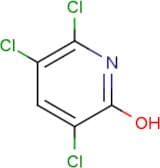
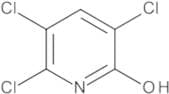
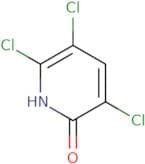
3,5,6-Trichloro-2-pyridinol, with the CAS number 6515-38-4, is a chlorinated derivative of pyridine, characterized by the presence of three chlorine atoms at the 3, 5, and 6 positions of the pyridine ring and a hydroxyl group at the 2 position. This compound is typically a white to light yellow solid, exhibiting moderate solubility in water and higher solubility in organic solvents. It is known for its use as an agricultural chemical, particularly as a fungicide and herbicide, due to its ability to inhibit certain biological processes in target organisms. The presence of multiple chlorine atoms contributes to its stability and persistence in the environment, although it may also raise concerns regarding toxicity and environmental impact. In terms of safety, it is important to handle this compound with care, as it may pose health risks upon exposure. Overall, 3,5,6-Trichloro-2-pyridinol is a significant compound in both agricultural applications and chemical research.
Formula:C5H2Cl3NO
InChI:InChI=1S/C5H2Cl3NO/c6-2-1-3(7)5(10)9-4(2)8/h1H,(H,9,10)
InChI key:InChIKey=WCYYAQFQZQEUEN-UHFFFAOYSA-N
SMILES:ClC1=C(Cl)NC(=O)C(Cl)=C1
Synonyms:- 2(1H)-Pyridinone, 3,5,6-trichloro-
- 2(1H)-Pyridone, 3,5,6-trichloro-
- 2,3,5-Trichloro-6-hydroxypyridine
- 2-Hydroxy-3,5,6-trichloropyridine
- 2-Hydroxyl-3,5,6-trichloropyridine
- 2-Pyridinol, 3,5,6-trichloro-
- 3,5,6 Trichloro 2-pyridinal
- 3,5,6-Trichloro-1H-pyridin-2-one
- 3,5,6-Trichloro-2(1H)-pyridinone
- 3,5,6-Trichloro-2-hydroxypyridine
- 3,5,6-Trichloropyridine-2-Diol
- 3,5,6-Trichloropyridine-2-Ol
- Hydroxy-3,5,6-trichloropyridine
- TCP
- 3,5,6-TRICHLOROPYRIDIN-2-OL
- Pyridinol,3,5,6-trichloro-
- TRICHLORO PYRIDINOL
- 3,5,6-TRICHLORO-2-PYRIDONE
- 3,5,6-TRICHLORO-2-PYRIDINOL
- 3,5,6-TRICHLORO-2-PYRIDINONE
- See more synonyms
Sort by
Purity (%)
0
100
|
0
|
50
|
90
|
95
|
100
Found 10 products.
3,5,6-Trichloropyridin-2(1H)-one
CAS:Formula:C5H2Cl3NOPurity:98%Color and Shape:SolidMolecular weight:198.43453,5,6-Trichloro-2-pyridinol 100 µg/mL in Acetonitrile
CAS:Formula:C5H2Cl3NOColor and Shape:Single SolutionMolecular weight:198.433,5,6-Trichloropyridine-2-ol
CAS:Formula:C5H2Cl3NOPurity:>95.0%(T)(HPLC)Color and Shape:White to Light yellow powder to crystalMolecular weight:198.433,5,6-Trichloro-2-pyridinol
CAS:Controlled ProductApplications A metabolite of Chlorpyrifos (C425300).
Not a dangerous good if item is equal to or less than 1g/ml and there is less than 100g/ml in the package
References Barron, M.G., et al.: Environ. Toxicol. Chem., 12, 1469 (1993), Tang, J., et al.: Drug Metab. Dispos., 29, 1201 (2001),Formula:C5H2Cl3NOColor and Shape:NeatMolecular weight:198.433,5,6-Trichloro-2-pyridinol
CAS:Formula:C5H2Cl3NOPurity:95%Color and Shape:SolidMolecular weight:198.43Sodium 3,5,6-trichloro-2-pyridinol Hydrate
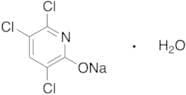
CAS:Controlled ProductApplications Sodium 3,5,6-trichloro-2-pyridinol is an important pesticide intermediate. New preparation process of insecticide chlorpyrifos.
References Liu, N., et al.: Xiandai Nongyao, 6, 14 (2007); Lu, Y., et al.: Huagong Jishu Yu Kaifa, 37, 5 (2008)Formula:C5HCl3NNaO•xH2OColor and Shape:NeatMolecular weight:220.42 + x(18.02)3,5,6-Trichloro-2-pyridinol
CAS:3,5,6-Trichloro-2-pyridinol (3,5,6-TCP) is an intermediate in the production of chlorpyrifos. It is also a metabolite of chlorpyrifos and has been detected in urine samples. 3,5,6-TCP can be determined by titrimetric analysis using sodium carbonate as a reagent. 3,5,6-TCP is toxic to both humans and animals at high doses. The process optimization for the synthesis of 3,5,6-TCP was investigated in order to reduce the amount of wastewater produced during production. In this study it was found that reaction solution pH was significantly lower when anhydrous sodium carbonate was used instead of water saturated sodium carbonate. This discovery would allow for more efficient wastewater treatment because less wastewater would need to be treated per unit product.Formula:C5H2Cl3NOPurity:Min. 95%Color and Shape:PowderMolecular weight:198.43 g/mol