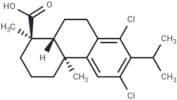
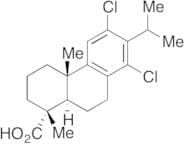
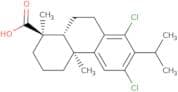
CAS 65281-77-8
:12,14-dichloroabieta-8(14),9(11),12-trien-18-oic acid
Description:
12,14-Dichloroabieta-8(14),9(11),12-trien-18-oic acid, with the CAS number 65281-77-8, is a synthetic compound derived from abietic acid, which is a natural resin acid found in pine trees. This substance features a complex polycyclic structure characterized by the presence of two chlorine atoms at the 12 and 14 positions, contributing to its unique chemical properties. The compound exhibits a triene configuration, indicating the presence of three conjugated double bonds within its structure, which can influence its reactivity and stability. As a carboxylic acid, it possesses a functional group (-COOH) that can participate in various chemical reactions, including esterification and acid-base reactions. The chlorinated nature of the compound may impart specific biological activities or environmental behaviors, making it of interest in fields such as medicinal chemistry or environmental science. However, detailed studies on its toxicity, environmental impact, and potential applications are essential for a comprehensive understanding of this compound.
Formula:C20H26Cl2O2
InChI:InChI=1/C20H26Cl2O2/c1-11(2)16-14(21)10-13-12(17(16)22)6-7-15-19(13,3)8-5-9-20(15,4)18(23)24/h10-11,15H,5-9H2,1-4H3,(H,23,24)/t15-,19-,20-/m1/s1
SMILES:CC(C)c1c(cc2c(CC[C@@H]3[C@]2(C)CCC[C@@]3(C)C(=O)O)c1Cl)Cl
Sort by
Purity (%)
0
100
|
0
|
50
|
90
|
95
|
100
Found 4 products.
12,14-Dichlorodehydroabietic acid
CAS:12,14-Dichlorodehydroabietic acid activates BK channels, blocks GABA A receptors, and increases calcium and neurotransmitter release.Formula:C20H26Cl2O2Color and Shape:SolidMolecular weight:369.3312,14-Dichlorodehydroabietic Acid (>90%)
CAS:Controlled ProductFormula:C20H26Cl2O2Purity:>90%Color and Shape:Off-WhiteMolecular weight:369.3312,14-Dichlorodehydroabietic acid
CAS:12,14-Dichlorodehydroabietic acid is a nicotinic acetylcholine receptor agonist that has been shown to inhibit the uptake of calcium ions and reduce the calcium overload in cells. This agent is used as a chemical intermediate in the production of vitamin E. It has also been used as a treatment for cardiac arrhythmias and has been demonstrated to provide an inhibitory effect on protein synthesis. 12,14-Dichlorodehydroabietic acid is activated by hydrolysis and reacts with free fatty acids to form 12,14-dichlorohydroabietic acid. The reaction mechanism involves activation energies at ca2+ concentrations between 0.5mM and 1mM. A kinetic study found that activation energy increases with increasing concentration of calcium ions present in the solution.Formula:C20H26Cl2O2Purity:Min. 95%Molecular weight:369.33 g/mol