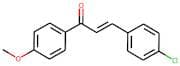
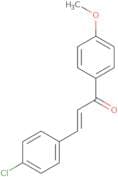
CAS 6552-68-7
:3-(4-chlorophenyl)-1-(4-methoxyphenyl)prop-2-en-1-one
Description:
3-(4-chlorophenyl)-1-(4-methoxyphenyl)prop-2-en-1-one, also known as a type of chalcone, is an organic compound characterized by its conjugated double bond system and the presence of aromatic rings. This compound features a prop-2-en-1-one backbone, which contributes to its reactivity and potential biological activity. The presence of a 4-chlorophenyl group and a 4-methoxyphenyl group enhances its lipophilicity and may influence its interaction with biological targets. Chalcones are known for their diverse pharmacological properties, including anti-inflammatory, antioxidant, and anticancer activities. The compound's structure allows for potential applications in medicinal chemistry and material science. It is typically synthesized through the Claisen-Schmidt condensation reaction, and its properties can be influenced by substituents on the aromatic rings. As with many organic compounds, safety and handling precautions should be observed, as it may exhibit toxicity or irritant effects.
Formula:C16H13ClO2
InChI:InChI=1/C16H13ClO2/c1-19-15-9-5-13(6-10-15)16(18)11-4-12-2-7-14(17)8-3-12/h2-11H,1H3
SMILES:COc1ccc(cc1)C(=O)C=Cc1ccc(cc1)Cl
Sort by
Purity (%)
0
100
|
0
|
50
|
90
|
95
|
100
Found 2 products.
3-(4-Chlorophenyl)-1-(4-methoxyphenyl)prop-2-en-1-one
CAS:3-(4-Chlorophenyl)-1-(4-methoxyphenyl)prop-2-en-1-onePurity:≥95%4-Chloro-4'-methoxychalcone
CAS:4-Chloro-4'-methoxychalcone (4MC) is a chalcone with an antibacterial activity. It is synthesized from 4,4'-dimethoxychalcone by substitution of one or two methoxy groups on the aromatic ring with chlorine atoms. 4MC has shown to be active against a number of different bacterial strains, including Staphylococcus aureus and Pseudomonas aeruginosa. The dilution method is used for the determination of the minimal inhibitory concentrations (MICs). This method involves serial dilutions in which bacteria are grown in liquid media containing increasing concentrations of the test compound. The lowest concentration of the test compound that inhibits bacterial growth is determined and recorded as MIC. Plutella xylostella larvae were found to be resistant to 4MC because they lack esterase enzymes that hydrolyze 4MC. Irradiation can be used to produce esters that are more reactive towardsFormula:C16H13ClO2Purity:Min. 95%Color and Shape:PowderMolecular weight:272.73 g/mol