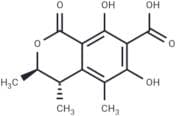
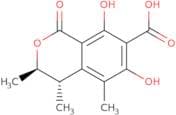
CAS 65718-85-6
:(3R,4S)-6,8-dihydroxy-3,4,5-trimethyl-1-oxo-3,4-dihydro-1H-isochromene-7-carboxylic acid
Description:
The chemical substance known as (3R,4S)-6,8-dihydroxy-3,4,5-trimethyl-1-oxo-3,4-dihydro-1H-isochromene-7-carboxylic acid, with the CAS number 65718-85-6, is a naturally occurring compound that belongs to the class of isochromenes. This compound features multiple hydroxyl groups, which contribute to its potential as a bioactive molecule, influencing its solubility and reactivity. The presence of a carboxylic acid functional group suggests that it can participate in acid-base reactions and may exhibit polar characteristics. Its stereochemistry, indicated by the (3R,4S) configuration, implies specific spatial arrangements that can affect its biological activity and interactions with other molecules. The trimethyl groups enhance its hydrophobic character, which may influence its permeability through biological membranes. Overall, this compound may have applications in pharmaceuticals or as a natural product with potential therapeutic properties, although specific biological activities would require further investigation.
Formula:C13H14O6
InChI:InChI=1/C13H14O6/c1-4-6(3)19-13(18)8-7(4)5(2)10(14)9(11(8)15)12(16)17/h4,6,14-15H,1-3H3,(H,16,17)/t4-,6-/m1/s1
SMILES:C[C@@H]1[C@@H](C)OC(=O)c2c1c(C)c(c(c2O)C(=O)O)O
Sort by
Purity (%)
0
100
|
0
|
50
|
90
|
95
|
100
Found 2 products.
Dihydrocitrinone
CAS:Dihydrocitrinone is a useful organic compound for research related to life sciences. The catalog number is T124457 and the CAS number is 65718-85-6.Formula:C13H14O6Color and Shape:SolidMolecular weight:266.25Dihydrocitrinone
CAS:Dihydrocitrinone is a weight-loss drug that has been shown to have cytotoxic activity in vitro. It is metabolized by rat liver microsomes into the major metabolites, dihydrocitrinone and citrinone. Dihydrocitrinone has also been shown to be stable when complexed with acetate extract and transport properties. The molecular modeling of dihydrocitrinone shows an interaction with glutathione reductase and cytochrome P450 enzyme. Dihydrocitrinone has been found in urine samples from humans, but not rats or mice, suggesting that this drug may be excreted through the kidneys. There are no known chemical structures for this drug, but it is thought to be an acid conjugate due to its low toxicity.Formula:C13H14O6Purity:85%MinColor and Shape:PowderMolecular weight:266.25 g/mol