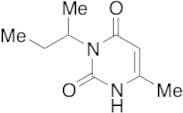
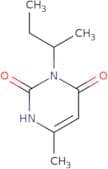
CAS 6589-36-2
:6-Methyl-3-(1-methylpropyl)-2,4(1H,3H)-pyrimidinedione
Description:
6-Methyl-3-(1-methylpropyl)-2,4(1H,3H)-pyrimidinedione, with the CAS number 6589-36-2, is an organic compound belonging to the pyrimidinedione class. This substance features a pyrimidine ring, which is a six-membered heterocyclic structure containing two nitrogen atoms at positions 1 and 3. The compound is characterized by the presence of a methyl group at the 6-position and a branched alkyl group (1-methylpropyl) at the 3-position, contributing to its unique chemical properties. It typically exhibits a solid state at room temperature and is soluble in organic solvents. The presence of the carbonyl groups in the pyrimidinedione structure imparts potential reactivity, making it useful in various chemical syntheses and applications. Additionally, the compound may exhibit biological activity, which could be of interest in pharmaceutical research. Its stability, solubility, and reactivity can vary based on environmental conditions, such as pH and temperature, which are important considerations in its handling and application.
Formula:C9H14N2O2
InChI:InChI=1S/C9H14N2O2/c1-4-7(3)11-8(12)5-6(2)10-9(11)13/h5,7H,4H2,1-3H3,(H,10,13)
InChI key:InChIKey=JXSCGNUFPLOCLH-UHFFFAOYSA-N
SMILES:C(CC)(C)N1C(=O)C=C(C)NC1=O
Synonyms:- 2,4(1H,3H)-Pyrimidinedione, 6-methyl-3-(1-methylpropyl)-
- 3-(butan-2-yl)-6-methylpyrimidine-2,4(1H,3H)-dione
- 3-sec-Butyl-6-methyl-1H-pyrimidine-2,4-dione
- 6-Methyl-3-(1-methylpropyl)-2,4(1H,3H)-pyrimidinedione
- NSC 310276
- Uracil, 3-sec-butyl-6-methyl-
- 3-sec-Butyl-6-methyluracil
Sort by
Purity (%)
0
100
|
0
|
50
|
90
|
95
|
100
Found 2 products.
3-(Butan-2-yl)-6-methyl-1,2,3,4-tetrahydropyrimidine-2,4-dione
CAS:<p>3-(Butan-2-yl)-6-methyl-1,2,3,4-tetrahydropyrimidine-2,4-dione is an aliphatic hydrocarbon that is used as a pesticide. It is detectable in the air by laboratory tests. 3-(Butan-2-yl)-6-methyl-1,2,3,4-tetrahydropyrimidine-2,4-dione has been shown to be zerovalent and reactive at high concentrations. This compound can be desorbed from algae surfaces using high concentrations of HCl. The kinetics of this compound are determined by its growth rate and concentration.</p>Formula:C9H14N2O2Purity:Min. 95%Molecular weight:182.2 g/mol