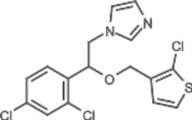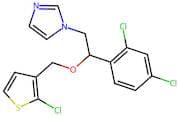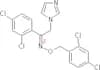
CAS 65899-73-2
:Tioconazole
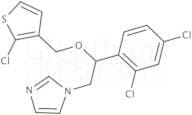
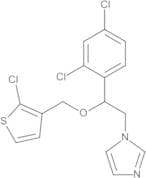
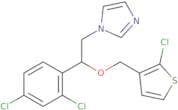
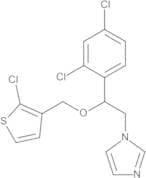
- 1-[2-[(2-Chloro-3-thienyl)methoxy]-2-(2,4-dichlorophenyl) ethyl]-1H-imidazole
- 1-[2-[(2-Chlorothiophen-3-yl)methoxy]-2-(2,4-dichlorophenyl)-ethyl]imidazole
- 1-{2-[(2-chlorothiophen-3-yl)methoxy]-2-(2,4-dichlorophenyl)ethyl}-1H-imidazole
- 1H-Imidazole, 1-[2-[(2-chloro-3-thienyl)methoxy]-2-(2,4-dichlorophenyl)ethyl]-
- Fungibacid
- Gyno-Trosyd
- New Straitus U
- Tioconazol
- Trosyd
- Trosyl
- Vagistat
- Vagistat 1
- Zoniden
- Tioconazole
- See more synonyms
Tioconazole
CAS:TioconazoleFormula:C16H13Cl3N2OSPurity:99.6%Color and Shape:WhiteMolecular weight:385.98142TIOCONAZOLE FOR SYSTEM SUITABILITY CRS
CAS:TIOCONAZOLE FOR SYSTEM SUITABILITY CRSFormula:C16H13Cl3N2OSColor and Shape:Crystalline Powder. White. Powder.Molecular weight:387.7112Tioconazole
CAS:Nucleic acids and their salts, whether or not chemically defined; other heterocyclic compounds, nesoiFormula:C16H13Cl3N2OSColor and Shape:PowderMolecular weight:385.981421-{2-[(2-chlorothiophen-3-yl)methoxy]-2-(2,4-dichlorophenyl)ethyl}-1H-imidazole
CAS:Formula:C16H13Cl3N2OSPurity:98%Color and Shape:SolidMolecular weight:387.7112Tioconazole
CAS:Tioconazole (Vagistat) is a synthetic imidazole derivative, inhibits cell wall synthesis by inhibiting the biosynthesis of ergosterol or other sterols.Formula:C16H13Cl3N2OSPurity:99.57%Color and Shape:SolidMolecular weight:387.71Tioconazole
CAS:Formula:C16H13Cl3N2OSPurity:≥ 98.0% (dried basis)Color and Shape:White or almost white powder or crystalsMolecular weight:387.71Tioconazole, Ph. Eur. grade
CAS:Formula:C16H13Cl3N2OSPurity:≤ 0.1%Color and Shape:White to almost white powderMolecular weight:387.71Tioconazole
CAS:Controlled ProductApplications Tioconazole is an antifungal that is more active than Fluconazole (F421000) or Voriconazole (V760000) against Candida glabrata mutant strains. Antifungal (topical).
References Jevons, S., et al.: Antimicrob. Agents Chemother., 15, 597 (1979), Clayton, Y.M., et al.: Clin. Exp. Dermatol., 7, 543 (1982), Marriott, M.S., et al.: Dermatologica, 166, 1 (1983),Formula:C16H13Cl3N2OSColor and Shape:WhiteMolecular weight:387.71Tioconazole
CAS:Tioconazole is an antifungal agent, which is a synthetic derivative of imidazole with broad-spectrum activity against fungi. This compound is chemically synthesized through complex organic reactions to enhance its antimycotic efficacy. Tioconazole functions by inhibiting the synthesis of ergosterol, an essential component of the fungal cell membrane. By disrupting the ergosterol biosynthesis pathway, tioconazole destabilizes the fungal cell membrane, leading to increased permeability and eventual cell death.
Formula:C16H13Cl3N2OSPurity:Min. 95%Molecular weight:387.71 g/mol


![1-{2-[(2-chlorothiophen-3-yl)methoxy]-2-(2,4-dichlorophenyl)ethyl}-1H-imidazole](/_next/image/?url=https%3A%2Fstatic.cymitquimica.com%2Fproducts%2FIN%2Fthumb%2FDA00IBJE.jpg&w=3840&q=75)