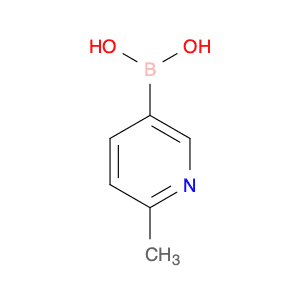
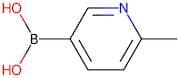
CAS 659742-21-9
:6-Methylpyridine-3-boronic acid
Description:
6-Methylpyridine-3-boronic acid is an organoboron compound characterized by the presence of a boronic acid functional group attached to a pyridine ring. This compound features a methyl group at the 6-position of the pyridine, which contributes to its unique reactivity and solubility properties. It is typically a white to off-white solid and is soluble in polar solvents such as water and alcohols, making it useful in various chemical reactions. The boronic acid group allows for participation in Suzuki coupling reactions, which are essential in the synthesis of biaryl compounds and pharmaceuticals. Additionally, 6-Methylpyridine-3-boronic acid can act as a ligand in coordination chemistry and is utilized in the development of sensors and in medicinal chemistry for drug design. Its reactivity can be influenced by the presence of the methyl group, which can affect sterics and electronic properties. As with many boronic acids, it is important to handle this compound with care, as it can be sensitive to moisture and air.
Formula:C6H8BNO2
InChI:InChI=1/C6H8BNO2/c1-5-2-3-6(4-8-5)7(9)10/h2-4,9-10H,1H3
SMILES:Cc1ccc(cn1)B(O)O
Synonyms:- 2-Picoline-5-boronic acid
- (6-Methyl-3-Pyridyl)Boronic Acid
- 2-Methyl-5-Pyridinylboronic Acid
- 2-Methylpyridine-5-Boronic Acid
Sort by
Purity (%)
0
100
|
0
|
50
|
90
|
95
|
100
Found 4 products.
(6-Methylpyridin-3-yl)boronic acid
CAS:Formula:C6H8BNO2Purity:96%Color and Shape:SolidMolecular weight:136.94426-Methylpyridine-3-boronic acid
CAS:6-Methylpyridine-3-boronic acidFormula:C6H8BNO2Purity:≥95%Color and Shape: white solidMolecular weight:136.94g/mol2-Methylpyridine-5-boronic acid
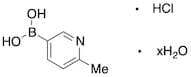
CAS:Formula:C6H8BNO2Purity:95%Color and Shape:SolidMolecular weight:136.956-Methylpyridine-3-boronic Acid Hydrochloride Hydrate
CAS:Controlled ProductStability Hygroscopic
Applications 6-Methylpyridine-3-boronic Acid Hydrochloride Hydrate is the Hydrochloride of M326565, which is used in the preparation of various biologically active compound such as phosphoinositide-3-kinases (PI3K) and c-jun N-terminal kinase (JNK) inhibitors.
References Smith, A.L. et al.: J. Med. Chem., 55, 5188 (2012); Perry, B. et al.: Bioorg. Med. Chem. Lett., 18, 4700 (2008); Chambers, J. et al.: ACS Chem. Neurosci., 2, 198 (2011);Formula:C6H8BNO2·HCl·xH2OColor and Shape:NeatMolecular weight:191.42