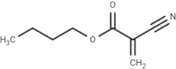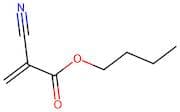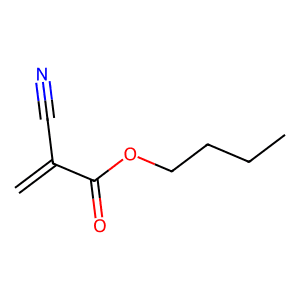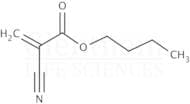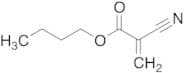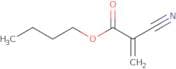
CAS 6606-65-1
:Butyl cyanoacrylate
- 1-Butyl 2-cyanoacrylate
- 2-Propenoic acid, 2-cyano-, butyl ester
- 3-Oxoheptanenitrile
- Acrylic acid, 2-cyano-, butyl ester
- BK 201 (adhesive)
- BK 301 (adhesive)
- Bk 200
- Bk 201
- Bk 300
- Bk 301
- Butyl 2-Cyanoprop-2-Enoate
- Butyl 2-cyanoacrylate
- Butyl cyanoacrylate
- Butyl α-cyanoacrylate
- Glubranh 1
- Histacryl Blue
- Hystoacryl
- Indermil
- Indermil Tissue Adhesive
- InteguSeal Clear
- Integuseal
- Integuseal Microbial Sealant
- Sicomet 6000
- Tisuacryl
- n-Butyl 2-cyanoacrylate
- n-Butyl cyanoacrylate
- NBCA
- BUTYLCYANOACRYLATE
- 2-propenoic,2-cyano-,butyl ester
- α-Cyanoacrylic acid butyl ester
- Enbucrilate 98%min
- enbucrilate
- n-Butyl α-Cyanoacrylate
- NBCA n-butyl cyanoacrylate tissue adhesive
- 2-Cyanoacrylic acid butyl
- 2-cyano-2-propenoic acid butyl ester
- See more synonyms
Enbucrilate
CAS:Enbucrilate, a surgical tissue adhesive, forms diverse polymer films at oil-water interfaces.Formula:C8H11NO2Purity:98% - 99.79%Color and Shape:SolidMolecular weight:153.18Ref: IN-DA00FCFK
100gTo inquire250gTo inquire100mg24.00€250mg29.00€500mg36.00€1g50.00€5g107.00€10g149.00€25g255.00€50g619.00€Butyl 2-Cyanoacrylate
CAS:Butyl 2-CyanoacrylatePurity:98%,stabilized with 100ppm HydroquinoneMolecular weight:153.18g/molButyl cyanoacrylate
CAS:Formula:C8H11NO2Purity:≥ 95.0%Color and Shape:Colourless to light yellow liquidMolecular weight:153.18Enbucrilate, Technical Grade
CAS:Controlled ProductApplications Enbucrilate is bacteriostatic and its use is usually painless. It is used as an adhesive for lacerations of the skin, and in the treatment of bleeding from vascular structures.
References Lee, B., et al.: J. Vasc. Surg., 39, 590 (2004); Ferguson, J., et al.: Aliment. Pharmacol. Ther., 18, 253 (2003)Formula:C8H11NO2Color and Shape:NeatMolecular weight:153.18Butyl cyanoacrylate
CAS:Butyl cyanoacrylate is a cyanoacrylate, a type of monomer that reacts with water to form a polymer. Cyanoacrylates are used in sealants and tissue adhesives because they form strong bonds with tissues and are biocompatible. Butyl cyanoacrylate has been shown to have an exothermic reaction when it is mixed with water, which can cause burns if the user is not careful. This product also has toxicological studies on fetal bovine and mammalian tissue. Butyl cyanoacrylate has been shown to inhibit vasoactive intestinal peptide release in the nervous system, which may be due to its ability to interfere with fatty acid metabolism.
Formula:C8H11NO2Purity:Min. 95%Color and Shape:Clear LiquidMolecular weight:153.18 g/mol