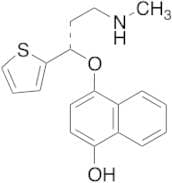
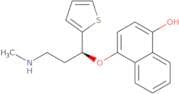
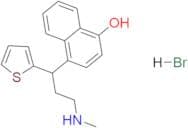
![4-[(1S)-3-(Methylamino)-1-(2-thienyl)propoxy]-1-naphthalenol](/_next/image/?url=https%3A%2Fstatic.cymitquimica.com%2Fcas-image%2Fthumb-webp%2F242077-4-hydroxy-duloxetine.webp&w=3840&q=75)
CAS 662149-13-5
:4-[(1S)-3-(Methylamino)-1-(2-thienyl)propoxy]-1-naphthalenol
Description:
4-[(1S)-3-(Methylamino)-1-(2-thienyl)propoxy]-1-naphthalenol, with the CAS number 662149-13-5, is a chemical compound that belongs to the class of naphthalenol derivatives. This substance features a naphthalene core, which is a polycyclic aromatic hydrocarbon, and is substituted with a propoxy group that contains a methylamino moiety and a thienyl ring. The presence of the thienyl group introduces heteroatoms into the structure, potentially affecting its reactivity and biological activity. The compound is likely to exhibit polar characteristics due to the hydroxyl (-OH) group and the amino (-NH) group, which can engage in hydrogen bonding. This may influence its solubility in various solvents and its interaction with biological systems. The stereochemistry indicated by the (1S) designation suggests specific spatial arrangements that could be crucial for its pharmacological properties. Overall, this compound may have applications in medicinal chemistry, particularly in the development of pharmaceuticals targeting specific biological pathways.
Formula:C18H19NO2S
InChI:InChI=1/C18H19NO2S/c1-19-11-10-17(18-7-4-12-22-18)21-16-9-8-15(20)13-5-2-3-6-14(13)16/h2-9,12,17,19-20H,10-11H2,1H3
InChI key:InChIKey=DRRXQCXSBONKPD-KRWDZBQOSA-N
SMILES:O([C@@H](CCNC)C1=CC=CS1)C=2C3=C(C(O)=CC2)C=CC=C3
Synonyms:- 4-[(1S)-3-(Methylamino)-1-(2-thienyl)propoxy]-1-naphthalenol
- 1-Naphthalenol, 4-[(1S)-3-(methylamino)-1-(2-thienyl)propoxy]-
- 4-Hydroxy Duloxetine
- 4-[(1S)-3-(Methylamino)-1-(2-thienyl)propoxy]-1-naphthaleno
Sort by
Purity (%)
0
100
|
0
|
50
|
90
|
95
|
100
Found 3 products.
4-Hydroxy Duloxetine
CAS:Applications A major metabolite of Duloxetine.
References Lantz, R.J., et al.: Drug Dispos. Metab., 31, 1142 (2003), Detke, M., et al.: J. Clin Psy., 63, 308 (2002), Bymaster, F.P., et al.: Bioorg. Med., Chem. Lett., 13, 4477 (2003),Formula:C18H19NO2SColor and Shape:NeatMolecular weight:313.414-Hydroxy duloxetine
CAS:Duloxetine is a potent inhibitor of cytochrome P450, which is an enzyme that metabolizes many drugs. Duloxetine inhibits the glucuronidation of 4-hydroxy duloxetine, leading to increased levels in the blood. Duloxetine has been shown to be effective in the treatment of diabetic neuropathy, with statistically significant improvements in symptoms and nerve conduction velocity. The pharmacokinetics of duloxetine has been studied in both rats and humans. In rats, duloxetine was found to have a large volume of distribution and a long half-life, suggesting that it is not well absorbed into the blood stream. In humans, duloxetine is metabolized by CYP2D6 and CYP3A4 enzymes. It has been shown to interact with other drugs such as warfarin, tizanidine, tramadol, and fluconazole.Formula:C18H19NO2SPurity:Min. 95%Color and Shape:Beige To Light Brown SolidMolecular weight:313.42 g/mol