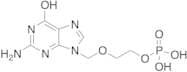
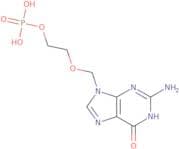
![2-[(2-amino-6-oxo-3,6-dihydro-9H-purin-9-yl)methoxy]ethyl dihydrogen phosphate](/_next/image/?url=https%3A%2Fstatic.cymitquimica.com%2Fcas-image%2Fthumb-webp%2F156090-2-2-amino-6-oxo-36-dihydro-9h-purin-9-yl-methoxy-ethyl-dihydrogen-phosphate.webp&w=3840&q=75)
CAS 66341-16-0
:2-[(2-amino-6-oxo-3,6-dihydro-9H-purin-9-yl)methoxy]ethyl dihydrogen phosphate
- 2-Amino-9-[(2-hydroxyethoxy)methyl]-1,9-dihydro-6H-purin-6-one phosphate (1:1)
- 6H-purin-6-one, 2-amino-1,9-dihydro-9-[(2-hydroxyethoxy)methyl]-, phosphate (1:1) (salt)
- Acycloguanosine monophosphate
- 2-amino-9-[(2-hydroxyethoxy)methyl]-1,9-dihydro-6H-purin-6-one phosphate (salt)
2-[(2-Amino-1,6-dihydro-6-oxo-9H-purin-9-yl)methoxy]ethyl dihydrogen phosphate
CAS:2-[(2-Amino-1,6-dihydro-6-oxo-9H-purin-9-yl)methoxy]ethyl dihydrogen phosphate
Purity:≥95%Molecular weight:305.18g/molAcyclovir Monophosphate
CAS:Stability Hygroscopic
Applications A nucleoside analog phosphates for topical use in the treatment of herpes virus infections. A topical treatment that seems to bypass a key mechanism responsible for resistance to Acyclovir.
References Furman, P., et al.: J. Virol., 32, 72 (1979), Darby, G., et al.: J. Gen. Virol., 48, 451 (1980),Prisbe, E., et al.: J. Med. Chem., 29, 671 (1986), Ellis, M., et al.: Antimicrob. Agents Chemother., 33, 304 (1989),Formula:C8H12N5O6PColor and Shape:Off-WhiteMolecular weight:305.18Acyclovir monophosphate
CAS:Acyclovir monophosphate, a strong anti-HSV agent, inhibits viral DNA polymerase, blocking DNA synthesis and chain elongation.Formula:C8H12N5O6PColor and Shape:SolidMolecular weight:305.18Acyclovir monophosphate
CAS:Acyclovir is a prodrug that is converted in vivo to its active form, acyclovir monophosphate. Acyclovir monophosphate inhibits DNA synthesis by human macrophages and other cells infected with viruses. Acyclovir inhibits the activity of the human enzyme, DNA polymerase. It binds reversibly to the viral DNA polymerase, preventing it from binding to the viral DNA and synthesizing new viral DNA strands. The hydroxyl group on acyclovir monophosphate reacts with the 3'-hydroxyl group on the terminal nucleotide of each dNTP, which prevents further elongation of the strand and thus blocks viral replication. Acyclovir also inhibits other enzymes that are important for cell metabolism, such as RNA polymerases and protein kinases. Acyclovir has minimal toxicity in humans and can be used as a diagnostic agent for hepatitis virus infections or as an antiviral agent for treating wild-type
Formula:C8H12N5O6PPurity:(%) Min. 95%Color and Shape:PowderMolecular weight:305.19 g/mol

![2-[(2-Amino-1,6-dihydro-6-oxo-9H-purin-9-yl)methoxy]ethyl dihydrogen phosphate](/_next/image/?url=https%3A%2Fstatic.cymitquimica.com%2Fproducts%2F54%2Fthumb%2FOR9250T.jpg&w=3840&q=75)