CAS 6641-32-3
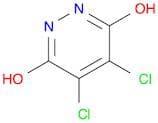
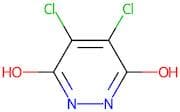
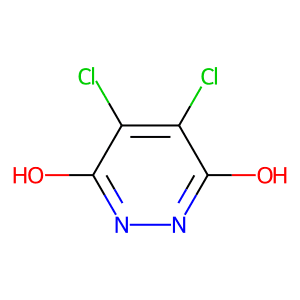
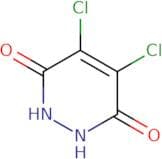
:4,5-dichloro-1,2-dihydropyridazine-3,6-dione
Description:
4,5-Dichloro-1,2-dihydropyridazine-3,6-dione, with CAS number 6641-32-3, is a heterocyclic organic compound characterized by its pyridazine ring structure, which is a six-membered ring containing two nitrogen atoms. This compound features two chlorine substituents at the 4 and 5 positions and two carbonyl groups at the 3 and 6 positions, contributing to its reactivity and potential biological activity. It is typically a solid at room temperature and may exhibit moderate solubility in polar solvents. The presence of the dichloro and dione functional groups suggests that it may participate in various chemical reactions, including nucleophilic substitutions and cycloadditions. Additionally, compounds of this type can be of interest in medicinal chemistry due to their potential pharmacological properties. Safety data should be consulted for handling, as halogenated compounds can pose health risks. Overall, 4,5-dichloro-1,2-dihydropyridazine-3,6-dione is a compound of interest in both synthetic and medicinal chemistry contexts.
Formula:C4H2Cl2N2O2
InChI:InChI=1/C4H2Cl2N2O2/c5-1-2(6)4(10)8-7-3(1)9/h(H,7,9)(H,8,10)
SMILES:c1(c(c(nnc1O)O)Cl)Cl
Synonyms:- 3,6-Pyridazinediol, 4,5-Dichloro-
- 4,5-Dichloropyridazine-3,6-diol
Sort by
Purity (%)
0
100
|
0
|
50
|
90
|
95
|
100
Found 5 products.
4,5-Dichloro-3,6-Pyridazinediol
CAS:Formula:C4H2Cl2N2O2Purity:95%Color and Shape:SolidMolecular weight:180.97694,5-Dichloropyridazine-3,6-diol
CAS:4,5-Dichloropyridazine-3,6-diolPurity:97%Molecular weight:180.98g/mol4,5-dichloro-1,2,3,6-tetrahydropyridazine-3,6-dione
CAS:4,5-dichloro-1,2,3,6-tetrahydropyridazine-3,6-dionePurity:97%Molecular weight:180.97688g/mol4,5-Dichloropyridazine-3,6-diol
CAS:Dichloropyridazine-3,6-diol is a furan derivative that has been shown to act as an inhibitor of the oxidative deamination of pyridine. It is also a nucleophilic reagent with a chlorine atom and two hydroxylamine groups in its structure. The carbonyl oxygen atom and the cyclic carbonyl group are both susceptible to oxidation and can be used to form chlorides. Dichloropyridazine-3,6-diol is resistant to acid chlorides such as thionyl chloride or phosphoric acid. This compound undergoes dehydration reactions with carboxylic acids and chlorides, yielding the corresponding carboxylate or chloride.
Formula:C4H2Cl2N2O2Purity:Min. 95%Molecular weight:180.97 g/mol