CymitQuimica logo

CAS 666-27-3

:

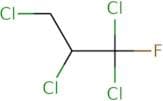
1,1,2,3-Tetrachloro-1-fluoropropane

Description:
1,1,2,3-Tetrachloro-1-fluoropropane, with the CAS number 666-27-3, is a halogenated organic compound characterized by its four chlorine atoms and one fluorine atom attached to a three-carbon propane backbone. This compound is typically a colorless liquid at room temperature and is known for its relatively high density and low volatility compared to other organic solvents. It is non-flammable and has a distinct chemical stability, making it useful in various industrial applications, particularly as a solvent or in the production of other chemicals. However, due to its halogenated nature, it may pose environmental and health risks, including potential toxicity and persistence in the environment. Its use is regulated in many regions due to concerns about its effects on human health and the ozone layer. Proper handling and disposal are essential to mitigate any adverse effects associated with exposure to this compound.
Formula:C3H3Cl4F
InChI:InChI=1S/C3H3Cl4F/c4-1-2(5)3(6,7)8/h2H,1H2
InChI key:InChIKey=AUCDWYVJFVHEHQ-UHFFFAOYSA-N
SMILES:C(C(Cl)(Cl)F)(CCl)Cl
Synonyms:
  • HCFC 241db
  • Propane, 1,1,2,3-tetrachloro-1-fluoro-
  • 1,1,2,3-Tetrachloro-1-fluoropropane
Sort by

Purity (%)
0
100
|
0
|
50
|
90
|
95
|
100
Found 1 products.
  • 1,1,2,3-Tetrachloro-1-fluoropropane

    Controlled Product
    CAS:
    <p>1,1,2,3-Tetrachloro-1-fluoropropane is a solvent that can be used to solvate organic compounds. It is volatile and has a boiling point of -78°C. This compound is used in the chlorination of methane and ethane, which produces 1,1,2-trichloroethane and 1,2-dichloroethane respectively. Hydrogen fluoride is also produced as an unwanted byproduct. The chlorine produced by this process is then catalyzed to form fluorine gas. This gas can be vaporized or depletes depending on the reaction conditions and the temperature of the reactor. Fluorine gas reacts with atmospheric water vapor to produce hydrofluoric acid (HF). When HF comes into contact with moist surfaces it will corrode them and produce hydrogen ions that react with metal oxides to produce metal salts and water. The emission of HF from chlorofluorocarbons</p>
    Formula:C3H3Cl4F
    Purity:Min. 95%
    Molecular weight:199.87 g/mol

    Ref: 3D-FT82116

    ne
    To inquire