CAS 66616-72-6
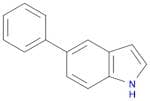
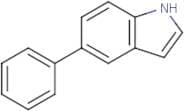
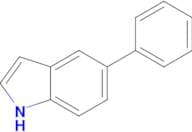
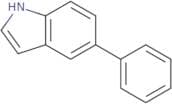
:5-Phenyl-1H-indole
Description:
5-Phenyl-1H-indole is an organic compound characterized by its indole structure, which consists of a fused benzene and pyrrole ring. The presence of a phenyl group at the 5-position of the indole ring enhances its aromaticity and can influence its chemical reactivity and biological activity. This compound typically exhibits a white to pale yellow crystalline appearance and is soluble in organic solvents such as ethanol and dichloromethane, but has limited solubility in water. 5-Phenyl-1H-indole is of interest in various fields, including medicinal chemistry and materials science, due to its potential applications in drug development and as a building block for synthesizing more complex molecules. Its properties, such as melting point, boiling point, and spectral data, can vary based on purity and specific conditions. Additionally, the compound may exhibit interesting photophysical properties, making it a candidate for studies in fluorescence and photochemistry. As with many indole derivatives, it may also show biological activity, warranting further investigation into its pharmacological potential.
Formula:C14H11N
InChI:InChI=1S/C14H11N/c1-2-4-11(5-3-1)12-6-7-14-13(10-12)8-9-15-14/h1-10,15H
InChI key:InChIKey=LPYXADUZSWBHCT-UHFFFAOYSA-N
SMILES:C=1(C=C2C(=CC1)NC=C2)C3=CC=CC=C3
Synonyms:- 1H-Indole, 5-phenyl-
- 5-Phenylindole
- 5-Phenyl-1H-indole
- 5-Phenyl-1H-indole
Sort by
Purity (%)
0
100
|
0
|
50
|
90
|
95
|
100
Found 4 products.
5-Phenyl-1H-indole
CAS:Phenylindole is a chemical compound that is used as a medicine to treat bacterial infections. It has been shown to inhibit the production of chemokines, which are proinflammatory cytokines that play an important role in the immune system. Phenylindole has been shown to cross-couple with biphenyl or other compounds and has antibacterial activity. It can be used for microscopy to optimize water content or other factors such as pH. Phenylindole inhibits bacterial growth by binding to the ribosomal RNA and preventing protein synthesis. The inhibitory effect can be observed through morphological changes, such as cell shrinkage or cell lysis. Phenylindole has also been found to have antifungal effects, which may be due to its ability to react with aryl halides or activate energy for aryl chlorides.Formula:C14H11NPurity:Min. 95%Molecular weight:193.25 g/mol