CAS 6669-13-2
:tert-Butyl phenyl ether
Description:
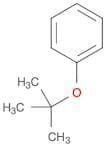
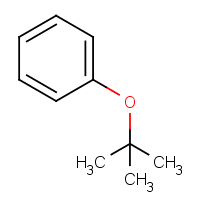
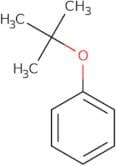
Tert-Butyl phenyl ether, with the CAS number 6669-13-2, is an organic compound classified as an ether. It features a tert-butyl group attached to a phenyl ring, which contributes to its unique properties. This compound is typically a colorless to pale yellow liquid with a characteristic aromatic odor. It is relatively non-polar, making it soluble in organic solvents while being less soluble in water. Tert-Butyl phenyl ether is known for its stability under normal conditions, but it can undergo reactions typical of ethers, such as cleavage under strong acidic conditions. It is often used as a solvent in organic synthesis and as a reagent in various chemical reactions. Additionally, it has applications in the production of pharmaceuticals and agrochemicals. Safety considerations include handling it in well-ventilated areas and using appropriate personal protective equipment, as it may pose health risks upon inhalation or skin contact. Overall, tert-Butyl phenyl ether is a versatile compound with significant utility in chemical processes.
Formula:C10H14O
InChI:InChI=1/C10H14O/c1-10(2,3)11-9-7-5-4-6-8-9/h4-8H,1-3H3
SMILES:CC(C)(C)Oc1ccccc1
Synonyms:- Benzene, (1,1-dimethylethoxy)-
- (1,1-Dimethylethoxy)benzene
- Tert-Butoxybenzene
Sort by
Purity (%)
0
100
|
0
|
50
|
90
|
95
|
100
Found 5 products.
tert-Butoxybenzene
CAS:Formula:C10H14OPurity:>98.0%(GC)Color and Shape:Colorless to Light yellow clear liquidMolecular weight:150.22tert-Butoxybenzene
CAS:Tert-Butoxybenzene is a chemical compound that is used to manufacture other chemicals. It is used as a reagent in organic synthesis, in particular for the preparation of derivatives of salicylic acid. Tert-Butoxybenzene can be detected by electron spin resonance spectroscopy and nuclear magnetic resonance spectroscopy. The health effects of tert-butoxybenzene are not well known, but it has been linked with cancer in animals and humans. Tert-butoxybenzene also reacts with hydrochloric acid to produce hydrogen chloride and benzyl alcohol. Further reactions lead to the formation of isobutene, which can be converted into propylene carbonate or alkylated to form methyl tert-butyl ether (MTBE).Formula:C10H14OPurity:Min. 95%Molecular weight:150.21 g/mol