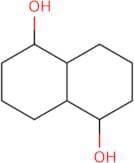
CAS 66818-21-1
:Decahydro-1,5-naphthalenediol
Description:
Decahydro-1,5-naphthalenediol, with the CAS number 66818-21-1, is a bicyclic organic compound characterized by its saturated naphthalene structure, which features two hydroxyl (-OH) groups at the 1 and 5 positions. This compound is typically a colorless to pale yellow solid at room temperature and is soluble in organic solvents due to its hydrophobic naphthalene core, while the hydroxyl groups provide some degree of polarity. The presence of these hydroxyl groups makes it a diol, which can participate in hydrogen bonding, influencing its physical properties such as boiling point and melting point. Decahydro-1,5-naphthalenediol is often used in organic synthesis and may serve as an intermediate in the production of various chemical compounds. Its reactivity can be attributed to the functional hydroxyl groups, allowing for further derivatization or reactions such as oxidation or esterification. Safety data should be consulted for handling, as with any chemical substance, to ensure proper precautions are taken.
Formula:C10H18O2
InChI:InChI=1S/C10H18O2/c11-9-5-1-3-7-8(9)4-2-6-10(7)12/h7-12H,1-6H2
InChI key:InChIKey=BABJMFGHXVXNKB-UHFFFAOYSA-N
SMILES:OC1C2C(C(O)CCC2)CCC1
Synonyms:- Decahydro-1,5-naphthalenediol
- Decahydronaphthalene-1,5-diol
- 1,5-Naphthalenediol, decahydro-
- 1,5-Decalindiol
Sort by
Purity (%)
0
100
|
0
|
50
|
90
|
95
|
100
Found 1 products.
1,5-Decalindiol
CAS:<p>1,5-Decalindiol is a cyclic alicyclic compound that can be synthesized by the Diels-Alder reaction between 1,5-hexadiene and maleic anhydride. It contains two stereoisomers with different reactivity. One isomer reacts more rapidly than the other one. The termination of 1,5-decalindiol is calcitriol, which can be synthesized by reacting 1,5-decalindiol with naphthalene. The sequence of reactions for the synthesis of 1,5-decalindiol are analyzed in detail. Methoxy groups on the a ring play an important role in the reaction rate of this molecule.<br>1,5-Decalindiol also has an interaction with acetonitrile and a reaction product with dihydroxynaphthalenes.</p>Formula:C10H18O2Purity:Min. 95%Color and Shape:PowderMolecular weight:170.25 g/mol