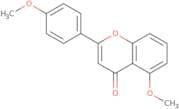
CAS 6697-63-8
:5-Methoxy-2-(4-methoxyphenyl)-4H-1-benzopyran-4-one
Description:
5-Methoxy-2-(4-methoxyphenyl)-4H-1-benzopyran-4-one, also known by its CAS number 6697-63-8, is a synthetic organic compound belonging to the class of flavonoids. This compound features a benzopyran backbone, which is characteristic of many flavonoids, and is substituted with methoxy groups that enhance its solubility and biological activity. It typically exhibits a yellow to orange color, indicative of its conjugated double bond system, which is common in flavonoids. The presence of methoxy groups can influence its chemical reactivity and interaction with biological systems, potentially contributing to antioxidant and anti-inflammatory properties. This compound may be of interest in various fields, including medicinal chemistry and natural product research, due to its potential therapeutic applications. Its solubility in organic solvents and moderate stability under standard conditions make it suitable for various experimental applications. However, specific properties such as melting point, boiling point, and spectral data would need to be referenced from experimental sources for precise applications.
Formula:C17H14O4
InChI:InChI=1S/C17H14O4/c1-19-12-8-6-11(7-9-12)16-10-13(18)17-14(20-2)4-3-5-15(17)21-16/h3-10H,1-2H3
InChI key:InChIKey=LUCPCQIWHDVLMX-UHFFFAOYSA-N
SMILES:O(C)C1=C2C(OC(=CC2=O)C3=CC=C(OC)C=C3)=CC=C1
Synonyms:- 4',5-Dimethoxyflavone
- 4H-1-Benzopyran-4-one, 5-methoxy-2-(4-methoxyphenyl)-
- 4′,5-Dimethoxyflavone
- 5,4′-Dimethoxyflavone
- 5-Methoxy-2-(4-methoxyphenyl)-4H-1-benzopyran-4-one
- 6697-63-8
- Flavone, 4′,5-dimethoxy-
Sort by
Purity (%)
0
100
|
0
|
50
|
90
|
95
|
100
Found 1 products.
5,4'-Dimethoxyflavone
CAS:5,4'-Dimethoxyflavone is a synthetic flavone, which is derived from modifications to the natural flavonoid backbone found in various plant sources, particularly within the family of citrus fruits. This compound acts primarily by modulating multiple cellular pathways, including those involved in oxidative stress and signal transduction, thereby influencing apoptotic and cell proliferation processes.Formula:C17H14O4Purity:Min. 95%Color and Shape:PowderMolecular weight:282.29 g/mol