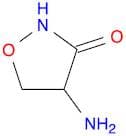
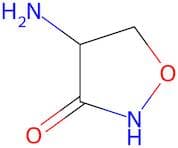
CAS 68-39-3
:4-Amino-3-isoxazolidinone
Description:
4-Amino-3-isoxazolidinone, with the CAS number 68-39-3, is a heterocyclic organic compound characterized by its isoxazolidinone ring structure, which includes both nitrogen and oxygen atoms. This compound typically appears as a white to off-white crystalline solid and is soluble in water and various organic solvents, making it versatile for different applications. It features an amino group (-NH2) that contributes to its reactivity and potential as a building block in organic synthesis. The presence of the isoxazolidinone moiety imparts unique chemical properties, allowing it to participate in various chemical reactions, including nucleophilic substitutions and cycloadditions. 4-Amino-3-isoxazolidinone is often studied for its biological activity, including potential pharmaceutical applications, as it may exhibit antimicrobial or anti-inflammatory properties. Safety data indicates that, like many chemical substances, it should be handled with care, following appropriate safety protocols to minimize exposure and risks. Overall, this compound is of interest in both academic research and industrial applications due to its structural features and reactivity.
Formula:C3H6N2O2
InChI:InChI=1S/C3H6N2O2/c4-2-1-7-5-3(2)6/h2H,1,4H2,(H,5,6)
InChI key:InChIKey=DYDCUQKUCUHJBH-UHFFFAOYSA-N
SMILES:NC1C(=O)NOC1
Synonyms:- 3-Oxoisooxazolidin-4-amine
- 4-Amino-3-isoxazolidinone
- DL-Cycloserine
- 3-Isoxazolidinone, 4-amino-
- 3-Isoxazolidinone, 4-amino-, (±)-
Sort by
Purity (%)
0
100
|
0
|
50
|
90
|
95
|
100
Found 5 products.
4-Aminoisoxazolidin-3-one
CAS:Formula:C3H6N2O2Purity:90%Color and Shape:SolidMolecular weight:102.093rac cycloserine
CAS:Racemic cycloserine is a drug that is used to treat tuberculosis. It is an anti-tuberculosis drug with the ability to inhibit bacterial growth by binding to fatty acids, which are required for the synthesis of mycolic acid and lipids. Cycloserine inhibits protein synthesis by inhibiting the function of RNA polymerase, leading to inhibition of bacterial growth. The uptake of racemic cycloserine into cells has been shown to be greater than that for l-cycloserine. This may be due to its higher affinity for fatty acid synthase and other cellular targets. Racemic cycloserine has also been shown to have antiviral effects against influenza virus in the cell culture system.Formula:C3H6N2O2Purity:Min. 95%Molecular weight:102.09 g/mol