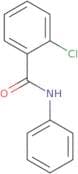
CAS 6833-13-2
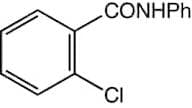
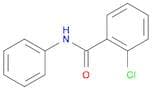
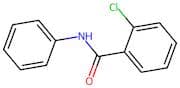
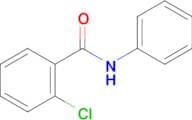
:2-chloro-N-phenylbenzamide
Description:
2-Chloro-N-phenylbenzamide is an organic compound characterized by its amide functional group, which consists of a benzene ring substituted with a chloro group and an N-phenyl group. This compound typically appears as a solid at room temperature and is soluble in organic solvents. The presence of the chloro substituent introduces unique reactivity, making it useful in various chemical reactions, including nucleophilic substitutions and coupling reactions. The amide bond contributes to its stability and influences its physical properties, such as melting and boiling points. Additionally, 2-chloro-N-phenylbenzamide may exhibit biological activity, making it of interest in pharmaceutical research. Its molecular structure allows for potential interactions with biological targets, which can be explored for therapeutic applications. As with many chlorinated compounds, it is essential to handle this substance with care due to potential toxicity and environmental concerns. Proper safety measures should be observed when working with this chemical in laboratory settings.
Formula:C13H10ClNO
InChI:InChI=1/C13H10ClNO/c14-12-9-5-4-8-11(12)13(16)15-10-6-2-1-3-7-10/h1-9H,(H,15,16)
SMILES:c1ccc(cc1)N=C(c1ccccc1Cl)O
Synonyms:- Benzamide, 2-chloro-N-phenyl-
Sort by
Purity (%)
0
100
|
0
|
50
|
90
|
95
|
100
Found 5 products.
2-Chloro-N-phenylbenzamide, 97%
CAS:This Thermo Scientific Chemicals brand product was originally part of the Alfa Aesar product portfolio. Some documentation and label information may refer to the legacy brand. The original Alfa Aesar product / item code or SKU reference has not changed as a part of the brand transition to Thermo SciFormula:C13H10ClNOPurity:97%Molecular weight:231.682-Chlorobenzanilide
CAS:2-Chlorobenzanilide is a chlorine compound that has been used to inhibit the growth of soil microorganisms. It is also an inhibitor of phenanthridone, which is an important intermediate in the synthesis of many herbicides. 2-Chlorobenzanilide can be prepared by reacting phenylhydrazine with chloroacetanilide. It can also be prepared by treating benzene with phosphorus chloride and then adding aniline to the reaction product. The rate of this reaction depends on the concentration of reactants, temperature, and pH. If more water is added to the reaction mixture, there will be a lower rate of reaction because hydroxide ions will compete with chloride ions for reactant molecules. The kinetic equation for this reaction follows:Formula:C13H10ClNOPurity:Min. 95%Molecular weight:231.68 g/mol