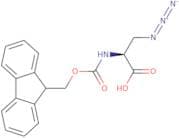
CAS 684270-46-0
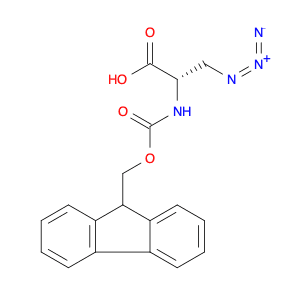
:Fmoc-Dap(N3)-OH
Description:
Fmoc-Dap(N3)-OH, with the CAS number 684270-46-0, is a chemical compound that belongs to the class of amino acids and is commonly used in peptide synthesis. The "Fmoc" (9-fluorenylmethoxycarbonyl) group is a protective group that is widely utilized in solid-phase peptide synthesis to protect the amino group of the amino acid, allowing for selective reactions at other functional groups. The "Dap" refers to 2,6-diaminopimelic acid, which is a lysine analog featuring an additional amino group, enhancing its reactivity and versatility in forming peptide bonds. The "(N3)" indicates the presence of an azide functional group, which can be utilized for further chemical modifications, such as click chemistry, making it valuable in bioconjugation and drug development. The hydroxyl (-OH) group at the end of the molecule contributes to its solubility and reactivity. Overall, Fmoc-Dap(N3)-OH is a significant building block in the synthesis of peptides and other complex biomolecules, facilitating the incorporation of diverse functionalities into peptide chains.
Sort by
Purity (%)
0
100
|
0
|
50
|
90
|
95
|
100
Found 7 products.
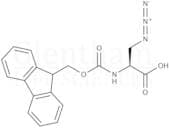
Fmoc-b-azido-Ala-OH
CAS:Formula:C18H16N4O4Purity:≥ 97.0%Color and Shape:White crystalline powderMolecular weight:352.34Fmoc-Dap(N3)
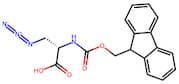
CAS:Fmoc-Dap(N3)Purity:>98%Color and Shape:White Powder (Lumps)Molecular weight:352.34g/molFmoc-L-azidoalanine
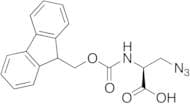
CAS:Controlled ProductFormula:C18H16N4O4Color and Shape:White To Off-WhiteMolecular weight:352.34Fmoc-β-azidoalanine
CAS:Fmoc-β-azidoalanine is a cyclic peptide that is synthesized by the Fmoc solid phase peptide synthesis method. It is used as a model for serine proteases, and its ability to bind to other molecules has been shown using molecular modelling and validation. Fmoc-β-azidoalanine has an acidic side chain that can form a disulfide bond with cysteine residues on proteins. This property allows it to be used in crystallography and chemical biology studies. The molecule can also be used in the study of human serum biomolecules.Formula:C18H16N4O4Purity:Min. 98 Area-%Color and Shape:PowderMolecular weight:352.34 g/mol