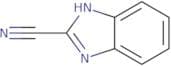
CAS 6868-37-7
:1H-Benzimidazole-2-carbonitrile
Description:
1H-Benzimidazole-2-carbonitrile, with the CAS number 6868-37-7, is a heterocyclic organic compound characterized by its benzimidazole core, which consists of a fused benzene and imidazole ring. This compound features a cyano group (-C≡N) attached to the second position of the benzimidazole ring, contributing to its chemical reactivity and potential applications. It is typically a crystalline solid, exhibiting moderate solubility in polar organic solvents. The presence of the cyano group enhances its utility in various chemical reactions, including nucleophilic substitutions and cycloadditions. 1H-Benzimidazole-2-carbonitrile is of interest in medicinal chemistry and materials science due to its biological activity and potential as a building block for more complex molecules. Its properties, such as melting point, boiling point, and spectral data, can vary based on purity and specific conditions. Overall, this compound serves as a versatile intermediate in organic synthesis and has implications in drug development and other chemical applications.
Formula:C8H5N3
InChI:InChI=1/C8H5N3/c9-5-8-10-6-3-1-2-4-7(6)11-8/h1-4H,(H,10,11)
SMILES:c1ccc2c(c1)[nH]c(C#N)n2
Sort by
Purity (%)
0
100
|
0
|
50
|
90
|
95
|
100
Found 3 products.
2-BENZIMIDAZOLCARBONITRILE
CAS:Formula:C8H5N3Purity:98%Color and Shape:SolidMolecular weight:143.14541H-Benzo[d]imidazole-2-carbonitrile
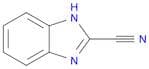
CAS:Formula:C8H5N3Purity:98%Color and Shape:SolidMolecular weight:143.1491H-Benzimidazole-2-carbonitrile
CAS:<p>1H-Benzimidazole-2-carbonitrile is a benzimidazole derivative that inhibits the growth of plants by inhibiting the activity of a plant enzyme called aspartate aminotransferase. This compound has been shown to inhibit the growth of several fungi and bacteria, including phytopathogenic fungi and bacteria from horticultural crops. It has also been shown to have significant antiproliferative activity against human tumor cells in culture. In addition, 1H-benzimidazole-2-carbonitrile is an inhibitor of apoptosis, which may be due to its ability to inhibit chloride ion channels on the plasma membrane of cells.</p>Formula:C8H5N3Purity:Min. 95%Molecular weight:143.15 g/mol

![1H-Benzo[d]imidazole-2-carbonitrile](/_next/image/?url=https%3A%2Fstatic.cymitquimica.com%2Fproducts%2F10%2Fthumb%2FF242415.jpg&w=3840&q=75)