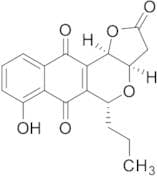
CAS 68930-68-7
:Frenolicin B
Description:
Frenolicin B is a natural compound classified as a polyketide, primarily produced by certain strains of the bacterium *Streptomyces*. It is known for its complex structure, which includes multiple rings and functional groups that contribute to its biological activity. Frenolicin B exhibits notable antimicrobial properties, making it of interest in pharmaceutical research, particularly for its potential applications in combating antibiotic-resistant bacteria. The compound has also been studied for its cytotoxic effects against various cancer cell lines, indicating potential as an anticancer agent. Its mechanism of action is thought to involve interference with cellular processes, although specific pathways are still under investigation. As with many natural products, the extraction and purification of Frenolicin B can be challenging due to its structural complexity and the presence of similar compounds in the producing organism. Overall, Frenolicin B represents a significant area of study in the search for new therapeutic agents derived from natural sources.
Formula:C18H16O6
InChI:InChI=1S/C18H16O6/c1-2-4-10-14-15(18-11(23-10)7-12(20)24-18)16(21)8-5-3-6-9(19)13(8)17(14)22/h3,5-6,10-11,18-19H,2,4,7H2,1H3/t10-,11-,18+/m1/s1
InChI key:InChIKey=AVCPRTNVVRPELB-YRUZYCQGSA-N
SMILES:O=C1C2=C([C@@H](CCC)O[C@]3([C@@]2(OC(=O)C3)[H])[H])C(=O)C=4C1=CC=CC4O
Synonyms:- (3aR,5R,11bR)-3,3a,5,11b-Tetrahydro-7-hydroxy-5-propyl-2H-furo[3,2-b]naphtho[2,3-d]pyran-2,6,11-trione
- (+)-Frenolicin B
- Frenolicin B
- 2H-Furo[3,2-b]naphtho[2,3-d]pyran-2,6,11-trione, 3,3a,5,11b-tetrahydro-7-hydroxy-5-propyl-, (3aR,5R,11bR)-
- 2H-Furo[3,2-b]naphtho[2,3-d]pyran-2,6,11-trione, 3,3a,5,11b-tetrahydro-7-hydroxy-5-propyl-, [3aR-(3aα,5α,11bα)]-
Sort by
Purity (%)
0
100
|
0
|
50
|
90
|
95
|
100
Found 3 products.
Frenolicin B
CAS:Frenolicin B is an antibiotic compound, which is primarily sourced from the fermentation of certain Streptomyces species, a group of filamentous bacteria known for their prolific production of antibiotics. This compound operates through the inhibition of bacterial cell wall synthesis, disrupting the structural integrity and functionality of the cell wall, ultimately leading to cell lysis and death.Formula:C18H16O6Purity:Min. 95%Molecular weight:328.32 g/mol