

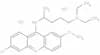
CAS 69-05-6
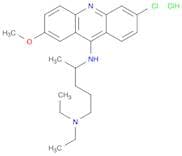
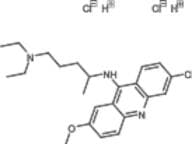
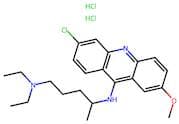
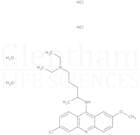
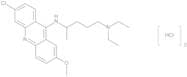
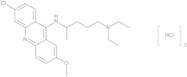
:Quinacrine dihydrochloride
- Acridine, 6-chloro-9-[[4-(diethylamino)-1-methylbutyl]amino]-2-methoxy-, dihydrochloride
- 866RP
- SN 390
- 1,4-Pentanediamine, N4-(6-chloro-2-methoxy-9-acridinyl)-N1,N1-diethyl-, dihydrochloride
- 1,4-Pentanediamine, N4-(6-chloro-2-methoxy-9-acridinyl)-N1,N1-diethyl-, hydrochloride (1:2)
2-Methoxy-6-chloro-9-(4-diethylamino-1-methylbutylamino)acridine dihydrochloride
CAS:Formula:C23H32Cl3N3OPurity:90%Color and Shape:SolidMolecular weight:472.8787Quinacrine dihydrochloride
CAS:Quinacrine dihydrochloride (Mepacrine dihydrochloride) is the dihydrochloride salt of the 9-aminoacridine derivative quinacrine with potential antineoplasticFormula:C23H30CLN3O·2HClPurity:98.24% - 99.80%Color and Shape:Yellow Crystals Or PowderMolecular weight:472.88N4-(6-Chloro-2-Methoxyacridin-9-Yl)-N1,N1-Diethylpentane-1,4-Diamine Dihydrochloride
CAS:N4-(6-Chloro-2-Methoxyacridin-9-Yl)-N1,N1-Diethylpentane-1,4-Diamine DihydrochloridePurity:98%Molecular weight:472.88g/molQuinacrine dihydrochloride
CAS:Formula:C23H30ClN3O·2HClPurity:(HPLC) ≥ 97.0%Color and Shape:Off-white to light yellow powderMolecular weight:472.88Mepacrine Hydrochloride
CAS:Controlled ProductFormula:C23H30ClN3OClHColor and Shape:NeatMolecular weight:472.88Quinacrine Dihydrochloride
CAS:Controlled ProductStability Hygroscopic
Applications Quinacrine 2HCl is a lipophilic cationic drug with multiple actions that is commonly used as an anti-protozoal agent. It is a non-selective MAO-A/B inhibitor.
References Bockelmann, S., et al.: J. Biol. Chem., 285, 38304 (2010); Wrench, A., et al.: PLoS ONE, 8, e54498 (2013); Kasymov, V., et al.: J. Neuroscience, 33, 435 (2013); Mori, T., et al.: Biol. Pharm. Bull., 35, 2243 (2012)Formula:C23H30ClN3O·2ClHColor and Shape:NeatMolecular weight:472.886-Chloro-9-[[4-(diethylamino)-1-methylbutyl]amino]-2-methoxyacridine dihydrochloride
CAS:6-Chloro-9-[[4-(diethylamino)-1-methylbutyl]amino]-2-methoxyacridine dihydrochloride (CMA) is a fluorescent dye that is used in the diagnosis of platelet disorders. It binds to the beta subunit of glycoprotein IIb/IIIa receptors on platelets, which are involved in the aggregation of platelets. CMA has shown to be effective against antibiotic resistant strains and may be useful for patients with infectious diseases. This drug has been shown to have cytosolic calcium ion (Ca2+) antagonist properties and an inhibitory effect on cell nuclei, as well as biological properties similar to mepacrine and atabrine.
Formula:C23H30ClN3O•(HCl)2Purity:Min. 98 Area-%Color and Shape:Slightly Yellow PowderMolecular weight:472.88 g/mol







![6-Chloro-9-[[4-(diethylamino)-1-methylbutyl]amino]-2-methoxyacridine dihydrochloride](/_next/image/?url=https%3A%2Fstatic.cymitquimica.com%2Fproducts%2F3D%2Fthumb%2FFC76313.jpg&w=3840&q=75)
