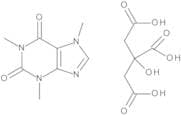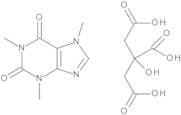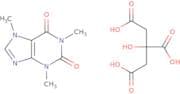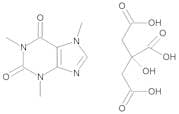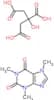
CAS 69-22-7
:Caffeine citrate
- 1,2,3-Propanetricarboxylic acid, 2-hydroxy-, mixt. with 3,7-dihydro-1,3,7-trimethyl-1H-purine-2,6-dione
- 1H-Purine-2,6-dione, 3,7-dihydro-1,3,7-trimethyl-, mixt. contg.
- 1H-purine-2,6-dione, 3,7-dihydro-1,3,7-trimethyl-, 2-hydroxy-1,2,3-propanetricarboxylate (1:1) (salt)
- Cafcit
- Caffeina citrate
- Caffeine Citrated
- Caffeine citrate
- Caffeine citrate (1:1)
- Caffeine, citrated [USAN]
- Cafnea
- Citrated caffein
- Citrated caffeine
- Citric acid, compd. with caffeine (1:1)
- Gencebok
- Peyona
- 1,3,7-Trimethyl-3,7-dihydro-1H-purine-2,6-dione 2-hydroxypropane-1,2,3-tricarboxylate (1:1)
- 1,3,7-TRIMETHYL-2,6-DIOXOPURINE CITRATE
- 1,3,7-Trimethyl-3,7-dihydro-purin-2,6-dion2-hydroxypropane-1,2,3-tricarboxylic acid,1,3,7-trimethyl
- thyl-1h-purine-2,6-dione
- 1,3,7-TRIMETHYLXANTHINE CITRATE
- Coffeinum-citrate
- citricacid,compd.withcaffeine(1:1)
- caffeinecitrate(1:1)
- CAFFEINE CITRATED GRANULAR
- caffeinacitrate
- Kaffein,Citrat
- COFFEINE CITRATE
- METHYLTHEOBROMINE CITRATE
- Caffeine Citrate USP
- Mixture with citric acid
- CAFFEINE,CITRATED,POWDER,PURIFIED
- GUARANINE CITRATE
- Caffeine, Citrated, Powder
- 2-HYDROXYPROPANE-1,2,3-TRICARBOXYLIC ACID,1,3,7-TRIMETHYLPURINE-2,6-DIONE
- citratedcaffein
- See more synonyms
Caffeine Citrate
CAS:Controlled ProductFormula:C8H10N4O2·C6H8O7Color and Shape:WhiteMolecular weight:386.31Caffeine Citrate
CAS:Applications Caffeine citrate (Cafcit) is a citrate salt of Caffeine, sometimes used in medical treatment, including short-term treatment of apnea of prematurity (lack of breathing in premature infants). Caffeine citrate functions in much the same capacity as does caffeine, but takes effect more quickly; its speed of dissociation is faster than that of Caffeine. Caffeine citrate is typically only used to treat severe migraines.
References Zubair, U.M., et al.: Anal. Profiles Drug Subs., 15, 71 (1986); Cherrah, Y., et al.: Biochem. Pharmacol., 37, 1311 (1988); Grillon, C., et al.: Clin. Neurophysiol., 114, 1557 (2003); Duangdao, D., et al.: Behav. Brain Res., 205, 1 (2009);Formula:C8H10N4O2·C6H8O7Color and Shape:WhiteMolecular weight:386.31Caffeine citrate
CAS:Controlled ProductCaffeine citrate is a low-dose caffeine product that has been shown to increase locomotor activity in rats. Caffeine citrate is an ester of caffeine and citric acid. It inhibits the enzyme that breaks down acetylcholine, which may lead to an increase in brain functions. Caffeine citrate is used as a treatment for apnea in pediatric patients, and it has also been shown to prevent bacterial translocation and reduce liver impairment caused by certain drugs. The therapeutic effect of caffeine citrate may be due to its ability to inhibit mitochondrial membrane potential, or its effects on basic proteins such as sodium citrate, or both.
Formula:C8H10N4O2·C6H8O7Color and Shape:White PowderMolecular weight:386.31 g/mol