CAS 69000-39-1
:2-chloro-N-(3-methylisoxazol-5-yl)acetamide
Description:
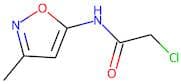
2-Chloro-N-(3-methylisoxazol-5-yl)acetamide is a chemical compound characterized by its unique structure, which includes a chloro group and an isoxazole moiety. The presence of the chloro substituent typically enhances the compound's reactivity, making it useful in various synthetic applications. The isoxazole ring contributes to the compound's biological activity, often influencing its pharmacological properties. This compound is likely to be a solid at room temperature, with moderate solubility in polar solvents due to the presence of the amide functional group, which can engage in hydrogen bonding. Its molecular structure suggests potential applications in medicinal chemistry, particularly in the development of pharmaceuticals targeting specific biological pathways. Additionally, the compound's stability and reactivity can be influenced by environmental factors such as pH and temperature. Safety data should be consulted for handling and storage, as halogenated compounds can pose health risks. Overall, 2-chloro-N-(3-methylisoxazol-5-yl)acetamide represents a versatile building block in organic synthesis and drug development.
Formula:C6H7ClN2O2
InChI:InChI=1/C6H7ClN2O2/c1-4-2-6(11-9-4)8-5(10)3-7/h2H,3H2,1H3,(H,8,10)
SMILES:Cc1cc(N=C(CCl)O)on1
Sort by
Purity (%)
0
100
|
0
|
50
|
90
|
95
|
100
Found 2 products.
N1-(3-methyl-5-isoxazolyl)-2-chloroacetamide
CAS:N1-(3-methyl-5-isoxazolyl)-2-chloroacetamidePurity:≥95%2-Chloro-N-(3-methyl-1,2-oxazol-5-yl)acetamide
CAS:2-Chloro-N-(3-methyl-1,2-oxazol-5-yl)acetamide (CMA) is a chitosan polymer that has been modified with cyclohexanone and glycolate to form nanoparticles. CMA was prepared by the solvent evaporation technique at room temperature. The process yielded a polymer with a molecular weight of about 1,500 Da. The resulting polymer showed good solubility in water, ethanol and acetone, but not in chloroform or benzene. CMA is used for the treatment of osteoporosis because it is able to regulate the synthesis of collagen, which is vital for bone mineralization. It also inhibits the production of prostaglandins that are involved in inflammatory processes.Formula:C6H7ClN2O2Purity:Min. 95%Molecular weight:174.58 g/mol