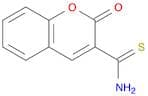
CAS 69015-65-2
:2-oxo-2H-chromene-3-carbothioamide
Description:
2-Oxo-2H-chromene-3-carbothioamide, identified by its CAS number 69015-65-2, is a chemical compound that belongs to the class of chromene derivatives. This compound features a chromene backbone, which is a bicyclic structure composed of a benzene ring fused to a pyran ring. The presence of a carbonyl group (oxo) and a thioamide functional group (carbothioamide) contributes to its unique reactivity and potential biological activity. Typically, compounds of this nature exhibit properties such as antioxidant, antimicrobial, or anti-inflammatory activities, making them of interest in medicinal chemistry. The structural characteristics, including the positioning of substituents on the chromene ring, can significantly influence the compound's chemical behavior and interactions. Additionally, the compound may exhibit solubility in organic solvents, and its stability can be affected by environmental factors such as pH and temperature. Overall, 2-oxo-2H-chromene-3-carbothioamide represents a versatile scaffold for further chemical modifications and potential applications in drug development.
Formula:C10H7NO2S
InChI:InChI=1/C10H7NO2S/c11-9(14)7-5-6-3-1-2-4-8(6)13-10(7)12/h1-5H,(H2,11,14)
SMILES:c1ccc2c(c1)cc(C(=N)S)c(=O)o2
Synonyms:- 2H-1-benzopyran-3-carbothioamide, 2-oxo-
Sort by
Purity (%)
0
100
|
0
|
50
|
90
|
95
|
100
Found 2 products.
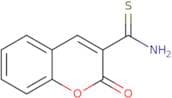
2-Oxo-2H-chromene-3-carbothioamide
CAS:2-Oxo-2H-chromene-3-carbothioamide is a synthetic compound that interacts with other molecules. It has been shown to interact with coumarin derivatives, yielding a 1:1 mixture of the two products. This interaction can be explained by the acceptor ability of the carbonyl group and the donor ability of the hydrogen atom on the carboxylic acid. The interaction between 2-Oxo-2H-chromene-3-carbothioamide and carbonyl compounds has been studied in detail and it can be predicted that it will react with other carbonyl compounds in a similar manner. 2-Oxo-2H-chromene-3-carbothioamide also reacts with peroxide to yield hydrogen peroxide, which is an example of a reaction that is not predictable.Formula:C10H7NO2SPurity:Min. 95%Molecular weight:205.23 g/mol