CAS 69321-60-4
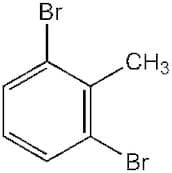
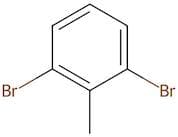
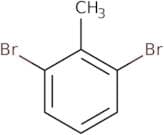
:2,6-Dibromotoluene
Description:
2,6-Dibromotoluene is an aromatic compound characterized by the presence of a toluene backbone with two bromine substituents located at the 2 and 6 positions of the benzene ring. Its molecular formula is C7H6Br2, indicating that it contains seven carbon atoms, six hydrogen atoms, and two bromine atoms. This compound typically appears as a colorless to pale yellow liquid or solid, depending on temperature and purity. It is known for its relatively high density and moderate boiling point compared to other toluene derivatives. 2,6-Dibromotoluene is primarily used in organic synthesis and as an intermediate in the production of various chemicals, including pharmaceuticals and agrochemicals. It exhibits properties typical of brominated aromatic compounds, such as increased reactivity in electrophilic substitution reactions. Additionally, it is important to handle this substance with care due to potential health hazards associated with brominated compounds, including toxicity and environmental concerns. Proper safety measures should be observed when working with or disposing of this chemical.
Formula:C7H6Br2
InChI:InChI=1/C7H6Br2/c1-5-6(8)3-2-4-7(5)9/h2-4H,1H3
SMILES:Cc1c(cccc1Br)Br
Synonyms:- 1,3-Dibromo-2-Methylbenzene
Sort by
Purity (%)
0
100
|
0
|
50
|
90
|
95
|
100
Found 5 products.
2,6-Dibromotoluene, 98+%
CAS:This Thermo Scientific Chemicals brand product was originally part of the Alfa Aesar product portfolio. Some documentation and label information may refer to the legacy brand. The original Alfa Aesar product / item code or SKU reference has not changed as a part of the brand transition to Thermo Sci
Formula:C7H6Br2Purity:98+%Color and Shape:Clear colorless, LiquidMolecular weight:249.942,6-Dibromotoluene
CAS:2,6-DibromotolueneFormula:C7H6Br2Purity:98%Color and Shape: colourless liquidMolecular weight:249.93g/mol2,6-Dibromotoluene
CAS:2,6-Dibromotoluene is a brominated organic compound with two functional groups. It can be used as a precursor to ferrocenes and as a synthetic intermediate for triazine herbicides. 2,6-Dibromotoluene is synthesized by the cross-coupling reaction of methylmagnesium bromide and benzaldehyde. The reaction solution is anhydrous sodium acetate in acetic acid at room temperature. This compound has three isomers: α-, β-, and γ-. The α-isomer has a helical structure and nmr spectra in the range of 1H (1.4 ppm) to 13C (63.5 ppm). Inelastic neutron scattering measurements on hexane solutions show that the β-isomer has a hexagonal structure with an inversion center at C3, while the γ-isomer has an octahedral structure with no inversion center.Formula:C7H6Br2Purity:Min. 95 Area-%Color and Shape:PowderMolecular weight:249.93 g/mol