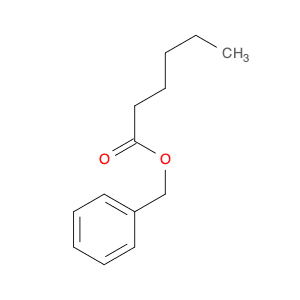
CAS 6938-45-0
:Benzyl hexanoate
Description:
Benzyl hexanoate, with the CAS number 6938-45-0, is an ester formed from the reaction of benzyl alcohol and hexanoic acid. It is characterized by its pleasant, fruity aroma, making it a popular choice in the fragrance and flavoring industries. This compound is typically a colorless to pale yellow liquid that is insoluble in water but soluble in organic solvents such as ethanol and ether. Benzyl hexanoate has a relatively low boiling point and a moderate density, which contributes to its volatility. It is often used as a flavoring agent in food products and as a fragrance component in cosmetics and personal care items. Additionally, it may have applications in the production of various chemical intermediates. Safety data indicates that while it is generally regarded as safe in low concentrations, it should be handled with care to avoid skin and eye irritation. Overall, benzyl hexanoate is valued for its aromatic properties and versatility in various applications.
Formula:C13H18O2
InChI:InChI=1S/C13H18O2/c1-2-3-5-10-13(14)15-11-12-8-6-4-7-9-12/h4,6-9H,2-3,5,10-11H2,1H3
InChI key:InChIKey=HRSXWUSONDBHSP-UHFFFAOYSA-N
SMILES:C(OC(CCCCC)=O)C1=CC=CC=C1
Synonyms:- Benzyl caproate
- Hexanoic acid, benzyl ester
- NSC 53964
- Hexanoic acid, phenylmethyl ester
- Benzyl hexanoate
Sort by
Purity (%)
0
100
|
0
|
50
|
90
|
95
|
100
Found 5 products.
Benzyl hexanoate
CAS:Benzyl hexanoate is a benzyl ester compound widely used in biochemical experiments and drug synthesis research.
Formula:C13H18O2Purity:97.17%Color and Shape:SolidMolecular weight:206.28benzyl hexanoate
CAS:Benzyl hexanoate is a conjugate that has been shown to have anticancer activity. It is synthesized by reacting benzaldehyde with hexanoic acid in the presence of acetic anhydride and pyridine. Benzyl hexanoate has been shown to be effective against cancer cells in vitro because it destabilizes lysosomes and inhibits protein synthesis. Benzyl hexanoate also has deodorizing properties, which are due to its ability to react with the acidic groups of odor producing molecules. The reaction results in the formation of new chemical structures that do not produce an odor or are less odorous.Formula:C13H18O2Purity:Min. 95%Color and Shape:Clear LiquidMolecular weight:206.29 g/mol