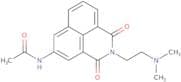
![N-{2-[2-(dimethylamino)ethyl]-1,3-dioxo-2,3-dihydro-1H-benzo[de]isoquinolin-5-yl}acetamide](/_next/image/?url=https%3A%2Fstatic.cymitquimica.com%2Fcas-image%2Fthumb-webp%2F373109-n-2-2-dimethylamino-ethyl-13-dioxo-23-dihydro-1h-benzo-de-isoquinolin-5-yl-acetamide.webp&w=3840&q=75)
CAS 69409-02-5
:N-{2-[2-(dimethylamino)ethyl]-1,3-dioxo-2,3-dihydro-1H-benzo[de]isoquinolin-5-yl}acetamide
- acetamide, N-[2-[2-(dimethylamino)ethyl]-2,3-dihydro-1,3-dioxo-1H-benz[de]isoquinolin-5-yl]-
N-Acetyl Amonafide
CAS:Controlled ProductApplications A metabolite of Amonafide.
References Felder, T.B., et al.: Drug Metab. Dispos., 15, 773 (1987), Frei, E., et al.: Cancer Res., 48, 6417 (1988), Liu, Y., et al.: Bioorg. Med. Chem., 14, 2935 (2006),Formula:C18H19N3O3Color and Shape:NeatMolecular weight:325.36N-Acetyl amonafide
CAS:N-Acetyl amonafide (NAA) is a potent antitumor agent that has shown activity against urothelial carcinoma, prostate cancer cells and skin cancer. It is an inhibitor of the uptake and efflux of anticancer drugs in tumor cells. NAA inhibits the growth of prostate cancer cells by inhibiting protein synthesis through inhibition of protein tyrosine phosphatase (PTP) activity. This drug has been shown to be effective in inhibiting the growth of human fetal bovine kidney cells and inducing apoptosis in these cells. NAA also inhibits the proliferation of human bladder cancer cells in culture by inhibiting DNA synthesis and causing cell cycle arrest. The molecular docking analysis revealed that NAA binds to topoisomerase II alpha, which is an enzyme involved in DNA replication, repair and transcription.
Formula:C18H19N3O3Purity:Min. 95%Molecular weight:325.36 g/molRef: 3D-FA17012
Discontinued product