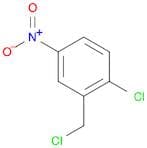
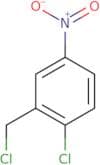
CAS 69422-57-7
:1-chloro-2-(chloromethyl)-4-nitrobenzene
Description:
1-Chloro-2-(chloromethyl)-4-nitrobenzene is an organic compound characterized by its aromatic structure, which includes a nitro group and two chloromethyl substituents on a benzene ring. This compound typically appears as a yellow to brown solid and is known for its moderate solubility in organic solvents such as dichloromethane and ether, while being less soluble in water. The presence of both chlorine and nitro groups contributes to its reactivity, making it a potential intermediate in various chemical syntheses, particularly in the production of pharmaceuticals and agrochemicals. Its chlorinated nature may impart certain toxicological properties, necessitating careful handling and storage. Additionally, the compound's stability under standard conditions allows it to be utilized in various chemical reactions, although it may undergo electrophilic substitution or nucleophilic attack due to the electron-withdrawing effects of the nitro group. As with many chlorinated compounds, environmental and health safety considerations are paramount, given the potential for persistence and bioaccumulation.
Formula:C7H5Cl2NO2
InChI:InChI=1/C7H5Cl2NO2/c8-4-5-3-6(10(11)12)1-2-7(5)9/h1-3H,4H2
SMILES:c1cc(c(cc1N(=O)=O)CCl)Cl
Sort by
Purity (%)
0
100
|
0
|
50
|
90
|
95
|
100
Found 2 products.
1-Chloro-2-(chloromethyl)-4-nitrobenzene
CAS:Formula:C7H5Cl2NO2Purity:95%Color and Shape:SolidMolecular weight:206.02611-Chloro-2-(chloromethyl)-4-nitrobenzene
CAS:<p>1-Chloro-2-(chloromethyl)-4-nitrobenzene is a chemical that is used as a reagent to measure creatinine in human urine. Creatinine is a natural product of muscle metabolism, and its concentration in the blood is usually used to estimate the rate of muscle breakdown. The creatinine content of urine can be determined by measuring the concentration of 1-chloro-2-(chloromethyl)-4-nitrobenzene. This compound has been shown to be metabolized to oxime, which can be quantified using gas chromatography with mass spectrometry (GC/MS) or liquid chromatography with mass spectrometry (LC/MS). The validation of this method for creatinine quantification in human urine has been done by analyzing different dilutions of urine samples and comparing them with their corresponding values from the standard curve. Emulsions are also used in this process as they can help increase accuracy</p>Formula:C7H5Cl2NO2Purity:Min. 95%Molecular weight:206.02 g/mol