CAS 69455-12-5
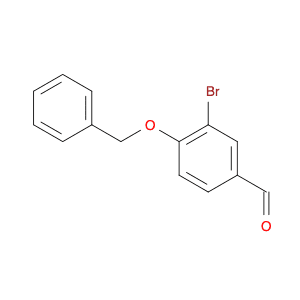
:4-(benzyloxy)-3-bromobenzaldehyde
Description:
4-(Benzyloxy)-3-bromobenzaldehyde is an organic compound characterized by its aromatic structure, which includes a bromine atom and a benzaldehyde functional group. The presence of the benzyloxy group enhances its reactivity and solubility in organic solvents. This compound typically appears as a pale yellow to light brown solid and has a moderate melting point. It is known for its applications in organic synthesis, particularly in the development of pharmaceuticals and agrochemicals, due to its ability to undergo various chemical reactions such as nucleophilic substitutions and electrophilic aromatic substitutions. The bromine atom serves as a useful handle for further functionalization, while the aldehyde group can participate in condensation reactions. Additionally, the compound's structure allows for potential interactions with biological targets, making it of interest in medicinal chemistry. Safety precautions should be taken when handling this compound, as it may pose health risks if ingested or inhaled, and proper storage conditions should be maintained to ensure stability.
Formula:C14H11BrO2
InChI:InChI=1/C14H11BrO2/c15-13-8-12(9-16)6-7-14(13)17-10-11-4-2-1-3-5-11/h1-9H,10H2
SMILES:c1ccc(cc1)COc1ccc(cc1Br)C=O
Synonyms:- Benzaldehyde, 3-Bromo-4-(Phenylmethoxy)-
Sort by
Purity (%)
0
100
|
0
|
50
|
90
|
95
|
100
Found 4 products.
4-(benzyloxy)-3-bromobenzenecarbaldehyde
CAS:Formula:C14H11BrO2Purity:97%Color and Shape:SolidMolecular weight:291.13994-(Benzyloxy)-3-bromobenzaldehyde
CAS:4-(Benzyloxy)-3-bromobenzaldehydePurity:97%Molecular weight:291.13994g/mol4-(Benzyloxy)-3-bromobenzaldehyde
CAS:Formula:C14H11BrO2Purity:97%Color and Shape:SolidMolecular weight:291.1444-Benzyloxy-3-bromobenzaldehyde
CAS:4-Benzyloxy-3-bromobenzaldehyde (4BBA) is a natural product that has been found to have high affinity for the histone deacetylase (HDAC) enzyme. 4BBA shows low cytotoxicity in fibroblast cells, which are cells that synthesize collagen, and it may be used as a fluorescent probe for HDACs in marine sponges. 4BBA binds to the cytoplasmic side of the cell's nucleus and exhibits fluorescence when excited with light at 350 nm. This fluorogenic activity is due to the phenyl ring and should allow for visualization of HDACs on the surface of cells using microscopy techniques.
Formula:C14H11BrO2Purity:Min. 95%Molecular weight:291.14 g/mol