CAS 69875-49-6
:4-chloroquinoline-3-carbonitrile
Description:
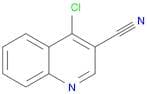
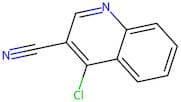
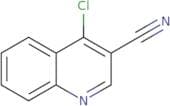
4-Chloroquinoline-3-carbonitrile is an organic compound characterized by its quinoline structure, which consists of a fused benzene and pyridine ring. The presence of a chlorine atom at the 4-position and a cyano group (-C≡N) at the 3-position contributes to its unique chemical properties. This compound typically appears as a solid and is known for its potential applications in pharmaceuticals and agrochemicals due to its biological activity. It may exhibit properties such as antimicrobial, antiviral, or anticancer activities, making it of interest in medicinal chemistry. The presence of the cyano group enhances its reactivity, allowing for further chemical modifications. Additionally, 4-chloroquinoline-3-carbonitrile is soluble in organic solvents, which is common for many quinoline derivatives. Safety data should be consulted for handling, as halogenated compounds can pose health risks. Overall, this compound represents a significant class of heterocyclic compounds with diverse applications in chemical research and development.
Formula:C10H5ClN2
InChI:InChI=1/C10H5ClN2/c11-10-7(5-12)6-13-9-4-2-1-3-8(9)10/h1-4,6H
SMILES:c1ccc2c(c1)c(c(C#N)cn2)Cl
Synonyms:- 3-Quinolinecarbonitrile, 4-chloro-
- 4-Chlorchinolin-3-carbonitril
- 4-Chloro-3-quinolinecarbonitrile
- 4-CHLORO-QUINOLINE-3-CARBONITRILE
- 4-Chloro-3-cyanoquinoline
Sort by
Purity (%)
0
100
|
0
|
50
|
90
|
95
|
100
Found 4 products.
4-Chloroquinoline-3-carbonitrile
CAS:Formula:C10H5ClN2Purity:97%Color and Shape:SolidMolecular weight:188.61314-Chloroquinoline-3-carbonitrile
CAS:4-Chloroquinoline-3-carbonitrilePurity:97%Molecular weight:188.617g/mol4-Chloro-quinoline-3-carbonitrile
CAS:Formula:C10H5ClN2Purity:97%Color and Shape:SolidMolecular weight:188.614-Chloroquinoline-3-carbonitrile
CAS:4-Chloroquinoline-3-carbonitrile is an intermediate in the synthesis of the tyrosine kinase inhibitor pelitinib and the process for its synthesis has been described. The synthetic process starts from acetonitrile, which reacts with nitrous acid to produce 4-chloroquinoline-3-carbonitrile. The next stage involves the reaction of 4-chloroquinoline-3-carbonitrile with ethyl acetate in the presence of a catalyst to produce 2-(4'-chlorophenyl)ethyl acetate. This compound can then be reacted with phenylethylamine to form (2E)-N-[2-(4'-chlorophenyl)ethyl]-N-(2,6-dimethoxyphenyl)acrylamide, which is a key intermediate in the synthesis of pelitinib.
Formula:C10H5ClN2Purity:Min. 95%Molecular weight:188.61 g/mol