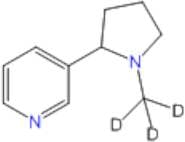
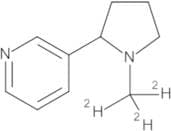
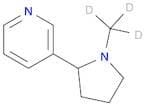
CAS 69980-24-1
:nicotine-methyl-D3
(+/-)-Nicotine-d3(N-methyl-d3)
CAS:Purity:99 atom % DColor and Shape:Colorless-Yellow Brown Liquid.Molecular weight:165.25rac-Nicotine-d3
CAS:Controlled ProductStability May Turn Brown on Exposure to Light or Air
Applications Labelled rac-Nicotine (N412420). Nicotine is an alkaloid isolated from plants. Nicotine is an active stimulant, having both addictive and carcinogenic properties. Nicotine can be absorbed through the alimentary canal, respiratory tract and intact skin. Nicotine is used in the treatment of smoking withdrawal syndrome. Nicotine has been used as an anthelmintic.
Not a dangerous good if item is equal to or less than 1g/ml and there is less than 100g/ml in the package
References Ferretti, G., et al.: J. Med. Chem., 45, 4724 (2002), Guillen, M., et al.: J. Agric. Food Chem., 53, 1093 (2005), Ramunno, A., et al.: Bioorg. Med. Chem. Lett., 15, 3237 (2005), Alburges, M., et al.: Eur. J. Pharmacol., 573, 124 (2007),Formula:C102H3H11N2Color and Shape:YellowMolecular weight:165.25(±)-Nicotine-d3
CAS:(±)-Nicotine-d3 is an indirubin analog that has shown promising anticancer activity. It acts as a kinase inhibitor, inhibiting the activity of protein kinases that are involved in cancer cell growth and proliferation. (±)-Nicotine-d3 induces apoptosis in human Chinese hamster ovary cells, which are commonly used to study the mechanisms of cancer development. This compound has been found to be effective against a wide range of tumors, including lung, breast, and prostate cancer. In addition, (±)-Nicotine-d3 can be detected in urine samples and may serve as a potential biomarker for cancer diagnosis and treatment monitoring. Overall, (±)-Nicotine-d3 is a potent inhibitor of kinases with promising anticancer properties.Formula:C10H14N2Purity:Min. 95%Molecular weight:165.25 g/mol