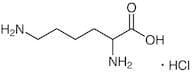
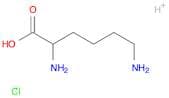
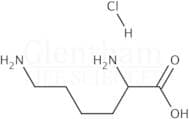
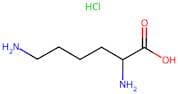
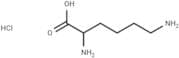
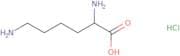
CAS 70-53-1
:Lysine, hydrochloride (1:1)
Description:
Lysine hydrochloride (1:1), with the CAS number 70-53-1, is a salt formed from the amino acid lysine and hydrochloric acid. It is a white crystalline powder that is highly soluble in water, making it suitable for various applications in biochemistry and nutrition. Lysine is classified as an essential amino acid, meaning it must be obtained through the diet, as the human body cannot synthesize it. This compound plays a crucial role in protein synthesis, hormone production, and the absorption of calcium. In addition to its nutritional importance, lysine hydrochloride is often used in dietary supplements and as a food additive to enhance the nutritional profile of various products. It is also utilized in pharmaceutical formulations due to its ability to stabilize proteins and improve their solubility. While generally considered safe, excessive intake may lead to gastrointestinal disturbances. Overall, lysine hydrochloride is valued for its functional properties in both health and industrial applications.
Formula:C6H14N2O2·ClH
InChI:InChI=1S/C6H14N2O2.ClH/c7-4-2-1-3-5(8)6(9)10;/h5H,1-4,7-8H2,(H,9,10);1H
InChI key:InChIKey=BVHLGVCQOALMSV-UHFFFAOYSA-N
SMILES:C(CCCCN)(C(O)=O)N.Cl
Synonyms:- 2,6-Diaminohexanoic acid hydrochloride
- <span class="text-smallcaps">DL</span>-Lysine hydrochloride
- <span class="text-smallcaps">DL</span>-Lysine, monohydrochloride
- D-lysine - L-lysine hydrochloride (1:1:2)
- DL-lysine monohydrochloride
- Lysine, hydrochloride (1:1)
- Lysine, monohydrochloride
- Lysine, monohydrochloride, <span class="text-smallcaps">DL</span>-
- NSC 46705
- Lysine, monohydrochloride, DL-
- DL-Lysine hydrochloride
Sort by
Purity (%)
0
100
|
0
|
50
|
90
|
95
|
100
Found 8 products.
DL-Lysine Monohydrochloride
CAS:Formula:C6H14N2O2·HClPurity:>98.0%(T)Color and Shape:White to Light yellow powder to crystalMolecular weight:182.65DL-Lysine monohydrochloride, 99%
CAS:DL-Lysine monohydrochloride acts as an intermediate in the preparation of 3-amino-azepan-2-one. It also serves as an essential amino acid. It is used as animal feed. In addition to this, it is used in the construction of polylysine polymers, which finds application in lysine-based polypeptide gelsFormula:C6H15ClN2O2Purity:99%Color and Shape:White to pale cream, PowderMolecular weight:182.65DL-Lysine monohydrochloride
CAS:Formula:C6H14N2O2·HClPurity:≥ 98.0%Color and Shape:White to off-white, crystalline powderMolecular weight:182.65H-DL-Lys-OH HCl
CAS:H-DL-Lys-OH HCl is the hydrochloride salt of lysine, widely used in biochemical experiments and drug synthesis research.Formula:C6H15ClN2O2Purity:99.94%Color and Shape:SolidMolecular weight:182.65DL-Lysine hydrochloride
CAS:The solubility of DL-Lysine hydrochloride in water is low, with a solubility of 0.01 g/100 mL at 25 °C. The pH of the solution is 7.0 and the concentration is 10.00%. The pH of the solution was determined using a pH meter. The concentration was determined by weight measurements using a balance and a volumetric flask. DL-Lysine hydrochloride reacts with hydrochloric acid to form an amide linkage between lysine residues on adjacent polypeptides or proteins, which may be used as a cross-linking agent for cell culture experiments. This compound has been shown to inhibit the growth of herpes simplex virus type 1 (HSV-1) in cell culture experiments, although it has no effect on HSV-2 because it lacks an amino group at position 2 on its side chain.Formula:C6H14N2O2·HClPurity:Min. 98%Color and Shape:PowderMolecular weight:182.65 g/mol2,6-Diaminohexanoic acid hydrochloride
CAS:Formula:C6H15ClN2O2Purity:97%Color and Shape:Solid, White to slightly pale yellow powderMolecular weight:182.65