CAS 700-91-4
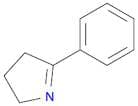
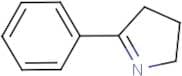
:5-phenyl-3,4-dihydro-2H-pyrrole
Description:
5-Phenyl-3,4-dihydro-2H-pyrrole, with the CAS number 700-91-4, is an organic compound characterized by its bicyclic structure, which includes a pyrrole ring fused with a phenyl group. This compound typically exhibits a pale yellow to light brown appearance and is known for its aromatic properties due to the presence of the phenyl substituent. The dihydropyrrole moiety contributes to its reactivity, making it a useful intermediate in organic synthesis, particularly in the development of pharmaceuticals and agrochemicals. It is generally soluble in organic solvents like ethanol and dichloromethane but may have limited solubility in water. The compound's stability can be influenced by environmental factors such as light and temperature, and it may undergo various chemical reactions, including oxidation and electrophilic substitution. Safety data indicates that, like many organic compounds, it should be handled with care, using appropriate safety measures to avoid inhalation or skin contact. Overall, 5-phenyl-3,4-dihydro-2H-pyrrole is a valuable compound in synthetic organic chemistry.
Formula:C9H10N2
InChI:InChI=1/C9H10N2/c1-2-9(11-5-1)8-3-6-10-7-4-8/h3-4,6-7H,1-2,5H2
SMILES:C1CC(=NC1)c1ccncc1
Synonyms:- 1-Pyrroline, 2-phenyl-
- 2H-pyrrole, 3,4-dihydro-5-phenyl-
- 5-Phenyl-3,4-dihydro-2H-pyrrol
- 4-(3,4-dihydro-2H-pyrrol-5-yl)pyridine
Sort by
Purity (%)
0
100
|
0
|
50
|
90
|
95
|
100
Found 3 products.
5-PHENYL-3,4-DIHYDRO-2H-PYRROLE
CAS:Formula:C10H11NPurity:97%Color and Shape:LiquidMolecular weight:145.20105-Phenyl-3,4-dihydro-2H-pyrrole
CAS:5-Phenyl-3,4-dihydro-2H-pyrroleFormula:C10H11NPurity:94%Color and Shape: yellow low melting solidMolecular weight:145.20g/mol5-Phenyl-3,4-dihydro-2H-pyrrole
CAS:5-Phenyl-3,4-dihydro-2H-pyrrole is a heterocyclic compound that is used in the synthesis of other chemicals. It can be positioned with a variety of functional groups and undergoes aromatisation by the cytochrome P450 enzyme system. 5-Phenyl-3,4-dihydro-2H-pyrrole reacts with perchlorates to form heterocycles such as pyrrolidine and activated pyrrole, which are used in supramolecular chemistry. 5PDP has been shown to react with haloalkanes to form bicyclic heterocycles such as 1,3,5-trioxane.Formula:C10H11NPurity:Min. 95%Molecular weight:145.2 g/mol