CAS 70023-02-8
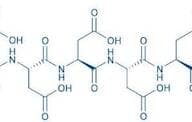
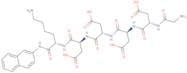
:gly-asp-asp-asp-asp-lys-B-naphthylamide
Description:
Gly-asp-asp-asp-asp-lys-B-naphthylamide, also known by its CAS number 70023-02-8, is a synthetic peptide that consists of a sequence of amino acids, specifically glycine (Gly), aspartic acid (Asp), and lysine (Lys), linked to a B-naphthylamide moiety. This compound is characterized by its unique structure, which combines both peptide and aromatic components, potentially influencing its biological activity and interactions. The presence of multiple aspartic acid residues may contribute to its ability to form hydrogen bonds and interact with various biological targets, while the B-naphthylamide group can enhance lipophilicity and facilitate membrane permeability. Such characteristics make it of interest in biochemical research, particularly in studies related to peptide synthesis, drug design, and molecular recognition. Its specific properties, such as solubility, stability, and reactivity, would depend on the conditions under which it is studied, including pH and temperature. Overall, this compound exemplifies the complexity and versatility of peptide-based molecules in medicinal chemistry.
Formula:C34H44N8O14
InChI:InChI=1/C34H44N8O14/c35-10-4-3-7-20(30(52)37-19-9-8-17-5-1-2-6-18(17)11-19)39-32(54)22(13-27(46)47)41-34(56)24(15-29(50)51)42-33(55)23(14-28(48)49)40-31(53)21(12-26(44)45)38-25(43)16-36/h1-2,5-6,8-9,11,20-24H,3-4,7,10,12-16,35-36H2,(H,37,52)(H,38,43)(H,39,54)(H,40,53)(H,41,56)(H,42,55)(H,44,45)(H,46,47)(H,48,49)(H,50,51)/t20-,21-,22?,23-,24-/m0/s1
SMILES:c1ccc2cc(ccc2c1)N=C([C@H](CCCCN)N=C(C(CC(=O)O)N=C([C@H](CC(=O)O)N=C([C@H](CC(=O)O)N=C([C@H](CC(=O)O)N=C(CN)O)O)O)O)O)O
Synonyms:- H-Gly-Asp-Asp-Asp-Asp-Lys-.beta.NA
- glycyl-L-alpha-aspartyl-L-alpha-aspartyl-L-alpha-aspartyl-alpha-aspartyl-N-naphthalen-2-yl-L-lysinamide
- Gly-Asp-Asp-Asp-Asp-Lys Beta-Naphthylamide
Sort by
Purity (%)
0
100
|
0
|
50
|
90
|
95
|
100
Found 3 products.
H-Gly-Asp-Asp-Asp-Asp-Lys-βNA
CAS:GDDDDK-βNA, specific substrate for the determination of enteropeptidase (enterokinase), also used in histochemistry.Formula:C34H44N8O14Purity:98.1%Color and Shape:WhiteMolecular weight:788.77Gly-L-Asp-L-Asp-L-Asp-L-Asp-L-Lys-beta-naphthylamide
CAS:Gly-L-Asp-L-Asp-L-Asp-L-Asp-L-Lys (GLAD) is a peptide that has been shown to inhibit the activity of protein kinases. GLAD binds to the ATP binding site and prevents ATP from binding to the kinase, which inhibits the phosphorylation of other proteins. GLAD may also activate certain protein kinases by binding to their ATP binding site. GLAD is a valuable research tool for studying protein interactions, as well as for identifying new receptor ligands and ion channels.Formula:C34H44N8O14Purity:Min. 95%Molecular weight:788.8 g/molH-Gly-Asp-Asp-Asp-Asp-Lys-bNA trifluoroacetic acid
CAS:H-Gly-Asp-Asp-Asp-Asp-Lys-bNA trifluoroacetic acid is a peptide that is used as a biocatalyst in the production of microspheres. It is also known as enterokinase, and cleaves proteins at their N termini. This enzyme has been immobilized on silica gel and then applied to the production of microspheres. The half life of this enzyme is 1 hour at 37°C, but it can be increased to 8 hours by immobilizing it on silica gel using glutaraldehyde. HGAASDAAKLysBNAtrifluoroacetic acid has been shown to have a high specific activity with an efficiency of 60% and a pH range between 4 and 10. It has been shown to have high protein cleavage rates at 30°C, 37°C, and 40°C, with bovine serum albumin being the
Formula:C38H45N8O16F3Purity:Min. 95%Molecular weight:788.76 g/mol