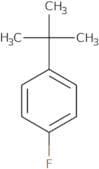
CAS 701-30-4
:1-(1,1-Dimethylethyl)-4-fluorobenzene
Description:
1-(1,1-Dimethylethyl)-4-fluorobenzene, also known as para-fluorotoluene, is an aromatic compound characterized by a fluorine atom and a tert-butyl group attached to a benzene ring. Its molecular formula is C10H13F, indicating the presence of ten carbon atoms, thirteen hydrogen atoms, and one fluorine atom. This compound typically appears as a colorless to pale yellow liquid with a distinctive aromatic odor. It has a relatively low boiling point and moderate solubility in organic solvents, making it useful in various chemical applications, including as a solvent and in the synthesis of other organic compounds. The presence of the fluorine atom enhances its reactivity and can influence its physical properties, such as polarity and boiling point. Additionally, 1-(1,1-Dimethylethyl)-4-fluorobenzene is of interest in research and industrial applications due to its potential use in pharmaceuticals and agrochemicals. As with many organic compounds, proper handling and safety precautions are essential due to its chemical nature.
Formula:C10H13F
InChI:InChI=1/C10H13F/c1-10(2,3)8-4-6-9(11)7-5-8/h4-7H,1-3H3
InChI key:InChIKey=ISXPXFQBHNIYCU-UHFFFAOYSA-N
SMILES:C(C)(C)(C)C1=CC=C(F)C=C1
Synonyms:- 1-(1,1-Dimethylethyl)-4-fluorobenzene
- 1-Fluoro-4-tert-butylbenzene
- 4-Fluoro-1-tert-butylbenzene
- 4-t-Butylfluorobenzene
- 4-tert-Butyl-1-fluorobenzene
- 4-tert-Butylfluorobenzene
- Benzene, 1-(1,1-dimethylethyl)-4-fluoro-
- Benzene, 1-tert-butyl-4-fluoro-
- 1-tert-Butyl-4-fluorobenzene
Sort by
Purity (%)
0
100
|
0
|
50
|
90
|
95
|
100
Found 2 products.
1-(tert-Butyl)-4-fluorobenzene
CAS:Formula:C10H13FPurity:≥95%Color and Shape:LiquidMolecular weight:152.2121-tert-Butyl-4-fluorobenzene
CAS:1-tert-Butyl-4-fluorobenzene is a nucleophile that is used as a substrate molecule in the reaction of acetonitrile with metal ions such as palladium and nickel. In the presence of these metals, 1-tert-butyl-4-fluorobenzene reacts with acetonitrile to form an intermediate, which then reacts with a boronic acid to produce the desired product. The addition of reductively active chloro ligands such as trichloroacetonitrile can be used for this transformation. This compound may also be used as an intermediate in reactions involving difluoride.Formula:C10H13FPurity:Min. 95%Molecular weight:152.21 g/mol