CAS 7017-48-3
:5-Bromo-2-methoxyphenylacetic acid
Description:
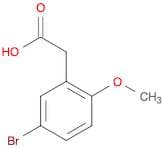
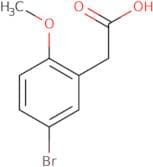
5-Bromo-2-methoxyphenylacetic acid is an organic compound characterized by its aromatic structure, which includes a bromine atom and a methoxy group attached to a phenyl ring. The presence of the carboxylic acid functional group (-COOH) contributes to its acidic properties. This compound typically appears as a white to off-white solid and is soluble in polar solvents, such as water and alcohols, due to the carboxylic acid group. Its molecular structure allows for potential interactions in biological systems, making it of interest in pharmaceutical research. The bromine substituent can influence the compound's reactivity and biological activity, while the methoxy group may enhance lipophilicity. 5-Bromo-2-methoxyphenylacetic acid is often used in organic synthesis and may serve as an intermediate in the production of various pharmaceuticals or agrochemicals. Safety data should be consulted for handling and storage, as with any chemical substance, to ensure proper precautions are taken.
Formula:C9H9BrO3
InChI:InChI=1/C9H9BrO3/c1-13-8-3-2-7(10)4-6(8)5-9(11)12/h2-4H,5H2,1H3,(H,11,12)
SMILES:COc1ccc(cc1CC(=O)O)Br
Synonyms:- 2-Methoxy-5-bromophenylacetic acid
- 2-(5-bromo-2-methoxyphenyl)ethanol
- JR-13632, 2-(5-Bromo-2-methoxyphenyl)acetic acid, 97%
- 5-Bromo-2-MethoxyphenylaceticAci
- 5-BROMO-2-METHOXYPHENYLACETIC ACID
- 2-(5-BroMo-2-Methoxyphenyl)acetic acid
- Benzeneacetic acid, 5-bromo-2-methoxy-
- RARECHEM AL BO 0337
Sort by
Purity (%)
0
100
|
0
|
50
|
90
|
95
|
100
Found 4 products.
2-(5-Bromo-2-methoxyphenyl)acetic acid
CAS:Formula:C9H9BrO3Purity:98%Color and Shape:SolidMolecular weight:245.07005-Bromo-2-methoxyphenylacetic acid
CAS:Formula:C9H9BrO3Purity:98%Color and Shape:SolidMolecular weight:245.0725-Bromo-2-methoxyphenylacetic acid
CAS:5-Bromo-2-methoxyphenylacetic acidFormula:C9H9BrO3Purity:98%Color and Shape: beige solidMolecular weight:245.07g/mol(5-Bromo-2-methoxyphenyl)acetic acid
CAS:5-Bromo-2-methoxyphenyl)acetic acid (BMPEA) is a hydroxylated derivative of aspartic acid. It has been shown to induce apoptotic cell death in various cell lines, including human lung cells and rat hippocampal cells. BMPEA is synthesized by the solid-phase method and is characterized by a constant structure. It can be used to treat degenerative diseases and other conditions where apoptosis is desirable, such as Alzheimer's disease, Parkinson's disease, amyotrophic lateral sclerosis, retinitis pigmentosa, and Duchenne muscular dystrophy.Formula:C9H9BrO3Purity:Min. 95%Color and Shape:PowderMolecular weight:245.07 g/mol