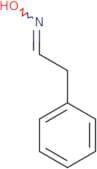
CAS 7028-48-0
:Phenylacetaldoxime
Description:
Phenylacetaldoxime, with the CAS number 7028-48-0, is an organic compound characterized by its oxime functional group attached to a phenylacetaldehyde structure. It typically appears as a colorless to pale yellow liquid or solid, depending on its purity and form. The compound is known for its ability to form coordination complexes with metal ions, making it useful in various chemical applications, including as a ligand in coordination chemistry. Phenylacetaldoxime is also recognized for its potential use in organic synthesis, particularly in the preparation of other chemical derivatives. Its molecular structure includes a phenyl group, which contributes to its aromatic properties, and an aldehyde moiety that can participate in various chemical reactions. Additionally, it exhibits moderate solubility in organic solvents, which enhances its utility in laboratory settings. Safety precautions should be observed when handling this compound, as it may pose health risks if ingested or inhaled. Overall, phenylacetaldoxime is a versatile compound with applications in both research and industrial chemistry.
Formula:C8H9NO
InChI:InChI=1S/C8H9NO/c10-9-7-6-8-4-2-1-3-5-8/h1-5,7,10H,6H2
InChI key:InChIKey=CXISHLWVCSLKOJ-UHFFFAOYSA-N
SMILES:C(C=NO)C1=CC=CC=C1
Synonyms:- 2-Phenylacetaldehyde oxime
- 2-Phenylethanal oxime
- Acetaldehyde, phenyl-, oxime
- Benzeneacetaldehyde, oxime
- Brn 2040645
- N-hydroxy-2-phenylethanimine
- Nsc 203259
- Phenylacetaldoxime
- Phenylacetaldehyde oxime
- 4-07-00-00665 (Beilstein Handbook Reference)
- 2-Phenylethanone oxime
- (Z)-phenylacetaldoxime
- See more synonyms
Sort by
Purity (%)
0
100
|
0
|
50
|
90
|
95
|
100
Found 1 products.
N-(2-Phenylethylidene)hydroxylamine
CAS:N-(2-Phenylethylidene)hydroxylamine is a methyl ethyl transfer agent. It is used in wastewater treatment to remove fatty acids, such as methyl ethyl and fatty acid esters, from water and industrial effluents. N-(2-Phenylethylidene)hydroxylamine is also used in the extraction of nasturtium officinale, an edible plant that belongs to the family Brassicaceae. The wild-type strain of this plant has been shown to be sensitive to N-(2-phenylethylidene)hydroxylamine. This chemical has also been shown to have potential as an oxidation catalyst for rat liver microsomes and neutral ph luciferase activity.Formula:C8H9NOPurity:Min. 95%Molecular weight:135.16 g/mol