CAS 704-15-4
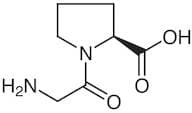
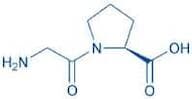
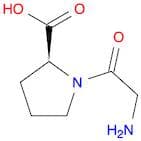
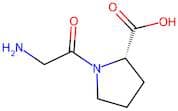
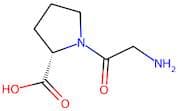
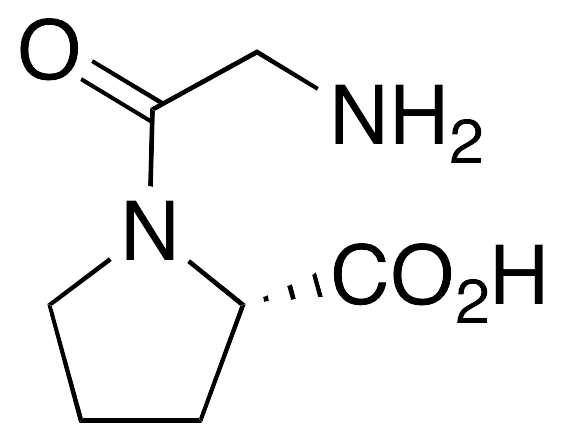
:Glycyl-L-proline
- (S)-1-(2-Aminoacetyl)pyrrolidine-2-carboxylic acid
- 1-Glycylproline
- 132: PN: US20130123467 SEQID: 158 claimed protein
- 152: PN: EP2161028 PAGE: 10 claimed protein
- 19: PN: WO2020009548 SEQID: 19 claimed protein
- 5: PN: WO2021055880 SEQID: 5 claimed protein
- 7: PN: WO03052099 PAGE: 83 claimed protein
- <span class="text-smallcaps">L</span>-Proline, 1-glycyl-
- <span class="text-smallcaps">L</span>-Proline, glycyl-
- GP (peptide)
- Glycyl-<span class="text-smallcaps">L</span>-proline
- Glycyl-L-proline
- Glycylproline
- H-Gly-Pro-OH
- N-Glycyl-<span class="text-smallcaps">L</span>-proline
- N-Glycylproline
- NSC 97929
- Proline, 1-glycyl-, <span class="text-smallcaps">L</span>-
- N-Glycyl-L-proline
- L-Proline, 1-glycyl-
- Proline, 1-glycyl-, L-
- See more synonyms
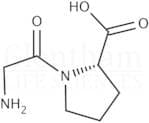
Glycyl-L-proline
CAS:Formula:C7H12N2O3Purity:>98.0%(HPLC)Color and Shape:White to Almost white powder to crystalMolecular weight:172.18H-Gly-Pro-OH
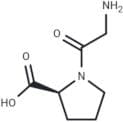
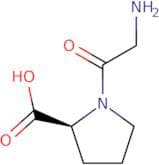
CAS:Substrate for skin fibroblast prolidase.Formula:C7H12N2O3Purity:> 99%Color and Shape:WhiteMolecular weight:172.18Glycyl-L-Proline
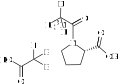
CAS:Formula:C7H12N2O3Color and Shape:White To Off-White SolidMolecular weight:172.18Glycyl-L-Proline-d2-15N Trifluoroacetate
CAS:Formula:C7H10D2N15NO3·C2HF3O2Color and Shape:White To Off-White SolidMolecular weight:175.19 114.02H-Gly-Pro-OH
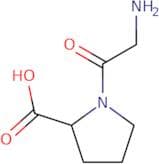
CAS:H-Gly-Pro-OH (Glycyl proline) is a dipeptide composed of glycine and proline, and is an end product of collagen metabolismFormula:C7H12N2O3Purity:≥95%Color and Shape:SolidMolecular weight:172.18N-Glycylproline
CAS:Applications N-Glycylproline was found to exhibit anti-ischemic effects on the metabolism of neuroactive amino acids and indices of energy turnover in the neocortex of rats after experimental brain ischemia.
References Bashun, Z.N., et al.: Neurochem. J., 7, 39 (2013);Formula:C7H12N2O3Color and Shape:NeatMolecular weight:172.182H-Gly-Pro-OH
CAS:Glycine is a non-essential amino acid that is used in the biosynthesis of proteins. It is also a precursor to porphyrins, which are important cofactors in many enzymes. Glycine can be converted to glyoxylate and subsequently to oxalate. Glycine plays an important role in the diagnosis of cancer tissue because it has been shown to have high levels of enzyme activities that are indicative for cancer cells. Glycine also has biological properties that make it suitable for use as an experimental model for metabolic disorders, such as energy metabolism, proton production and human serum.
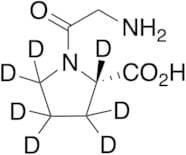
Formula:C7H12N2O3Purity:Min. 95%Color and Shape:PowderMolecular weight:172.18 g/molN-Glycyl-L-proline-D7
CAS:Controlled ProductFormula:C7D7H5N2O3Color and Shape:NeatMolecular weight:179.225Gly-Pro
CAS:Gly-Pro is a cyclic peptide that binds to DPP-IV and inhibits proteolytic activity. It has been shown to have inhibitory properties against infectious diseases and cancer tissues, as well as a fluorescence probe for the detection of DPP-IV. Gly-Pro is also a potential inhibitor of neuronal death and has been shown to have structural analysis in the form of molecular docking analysis.
Formula:C7H12N2O3Purity:Min. 95%Molecular weight:172.18 g/mol