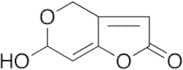
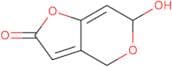
![6-hydroxy-4H-furo[3,2-c]pyran-2(6H)-one](/_next/image/?url=https%3A%2Fstatic.cymitquimica.com%2Fcas-image%2Fthumb-webp%2F383863-6-hydroxy-4h-furo-32-c-pyran-2-6h-one.webp&w=3840&q=75)
CAS 70402-10-7
:6-hydroxy-4H-furo[3,2-c]pyran-2(6H)-one
Description:
6-Hydroxy-4H-furo[3,2-c]pyran-2(6H)-one, also known by its CAS number 70402-10-7, is a chemical compound characterized by its unique fused ring structure that combines a furan and pyran moiety. This compound typically exhibits a hydroxyl group at the 6-position, contributing to its reactivity and potential biological activity. It is often studied for its potential applications in pharmaceuticals and natural product chemistry due to its structural features that may influence its interaction with biological systems. The presence of the furan and pyran rings suggests that it may participate in various chemical reactions, including those involving electrophilic and nucleophilic sites. Additionally, compounds of this type may exhibit antioxidant properties, making them of interest in the study of health-related applications. Its solubility and stability can vary depending on the solvent and environmental conditions, which are important factors to consider in experimental settings. Overall, 6-hydroxy-4H-furo[3,2-c]pyran-2(6H)-one represents a fascinating subject for further research in organic and medicinal chemistry.
Formula:C7H6O4
InChI:InChI=1/C7H6O4/c8-6-2-5-4(3-10-6)1-7(9)11-5/h1-2,6,8H,3H2
SMILES:C1=C2COC(C=C2OC1=O)O
Synonyms:- 4H-Furo(3,2-c)pyran-2(6H)-one, 6-hydroxy-
Sort by
Purity (%)
0
100
|
0
|
50
|
90
|
95
|
100
Found 3 products.
Neopatulin
CAS:Controlled ProductApplications Neopatulin is a mycotoxic substance which is produced by Penicillium and Aspergillus species. The molecule possesses useful antibiotic and antibacterial properties, but it is also an unwelcome contaminant in food and a general plant toxin.
References Ellis, J.R., et al.: Appl. Microbiol., 25, 562 (1973), Priest, J.W., et al.: Biochemistry, 28, 9192 (1989),Formula:C7H6O4Color and Shape:NeatMolecular weight:154.12Neopatulin
CAS:Neopatulin is a naturally occurring compound classified as a bioactive agent, which is derived from certain species of fungi, particularly from Penicillium. Its mode of action involves disrupting microbial cell function, making it effective as an antimicrobial agent. The compound interferes with cell wall synthesis and metabolic processes of the microorganisms, ultimately inhibiting their growth and proliferation.Formula:C7H6O4Purity:Min. 95%Molecular weight:154.12 g/mol